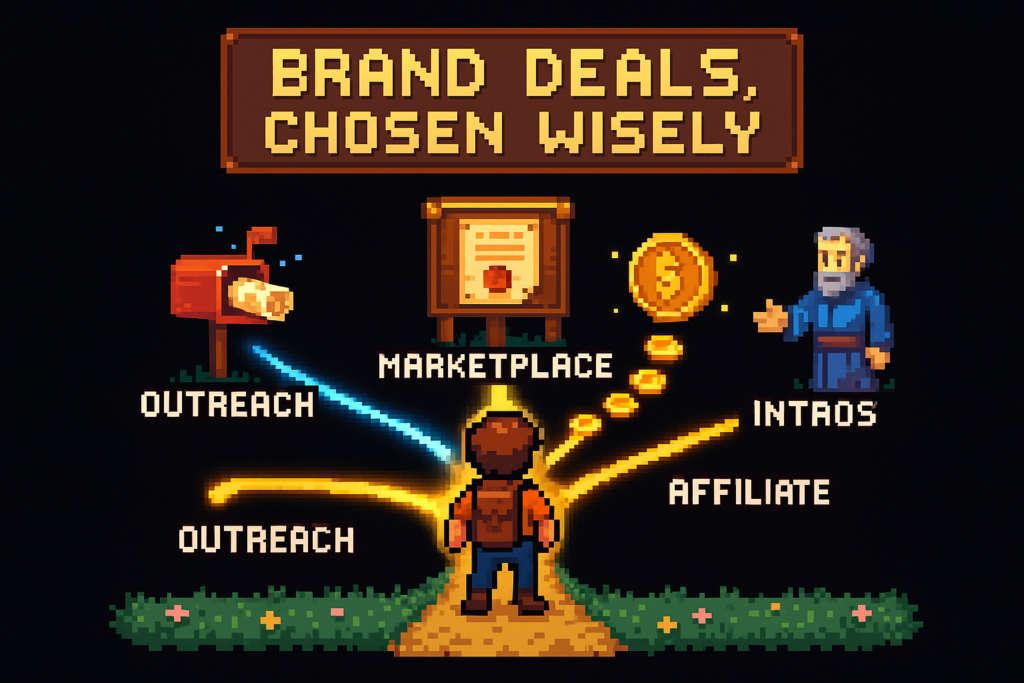
You sent one pitch, heard nothing back, and started wondering if brand deals were only for creators with huge followings. They aren't. Usually, the problem isn't audience size. It's path fit. If you're using the wrong approach for your stage, niche, and proof, even a strong creator can look like a weak bet.
That's why this gets confusing fast. One creator lands paid collaborations through cold outreach. Another gets inbound emails. Another starts with affiliate revenue. Another skips the whole pitch process by activating marketplace deals.
The shift happens when you stop asking, “How do I get sponsorships?” and start asking, “Which path can I support with proof right now?”
Brand deals are paid or performance-based partnerships between a creator and a company. They can include flat-fee sponsored content, affiliate partnerships, product seeding, marketplace deals, or longer-term brand partnerships.
Getting brand deals doesn’t just mean landing a one-off sponsored post.
It can also mean building recurring creator income through commissions, repeat campaigns, and product partnerships that fit your audience.
Related pieces you'll hear throughout this guide: a creator media kit is your one-page proof sheet, a rate card is your starting pricing structure, an affiliate partnership pays based on performance, a campaign brief outlines the concept and deliverables, and audience demographics help brands judge fit.
| Best path based on your situation | Start here |
|---|---|
| You're new and don't have sponsorship proof yet | Affiliate-first partnerships, product seeding, marketplace deals |
| You have niche content and some conversion data | Selective direct outreach |
| Brands already find your content organically | Inbound attraction plus warm follow-up |
| You already recommend Amazon products | Amazon Associates plus Lasso's creator marketplace |
| You know other creators or brand contacts | Warm introductions layered on top of your proof |
How creators actually get brand deals today
Creators rarely follow one clean path. Most move through a few of them as their proof gets stronger. Early on, that often means product mentions and affiliate links. Later, it can mean custom sponsored content and longer-term brand partnerships.
The four main paths are direct outreach, inbound attraction, affiliate-first partnerships, and marketplace deals. Warm introductions can help across all four. They don't replace the work, but they can improve reply rates once you have something worth showing.
A one-off brand deal is a single campaign. A brand partnership is a relationship. That distinction matters because the best path depends on what you're trying to win. If you want one paid post, a specific pitch can work. If you want recurring work, brands need to see consistency, audience trust, and proof of conversion.
Myth: You need 100,000 followers to get brand deals.
Reality: Brands often care more about niche fit, trust, and buying intent than raw reach.
A home office creator with 8,000 YouTube subscribers is a good example. If they cold email standing desk brands asking for a $2,000 sponsorship with no proof, they'll probably get ignored. But if they've already mentioned desk lamps, monitor arms, and cable trays in weekly videos, they can start with affiliate partnerships on products they already recommend. Once they can show clicks, conversions, and a few relevant mentions, direct outreach gets much easier.
We've seen this pattern across creator monetization for years. Proof opens doors. Reach just changes how wide they swing.
Direct outreach, the highest-control path
Direct outreach gives you the most control over the offer, the angle, and the brand list. It's best when you know your niche well, have relevant content already live, and can pitch a specific idea instead of a vague collaboration request.
The upside is higher because custom deals can include flat fees, usage rights, bundles, and repeat campaigns. But the downside is obvious. It's slower, more manual, and full of rejection if your pitch isn't tight.
A focused brand deal outreach strategy beats mass emailing every time. Ten aligned brands with tailored ideas will usually outperform fifty generic pitches.
Inbound attraction, the slowest start but strongest compounding path
Inbound happens when brands find you because your content is searchable, your niche is clear, and your positioning makes sense. This path starts slow, but it compounds. Every strong review, tutorial, roundup, or case study becomes another proof asset working in the background.
Brands that reach out inbound are often warmer leads. They've already seen your content, checked your audience demographics, and decided you're relevant enough to contact.
This works best for creators with a growing content library and a clear point of view. If your channel covers a little bit of everything, inbound usually stays weak.
Affiliate-first partnerships and marketplace deals, the easiest on-ramp
A lot of creators don't land their first paid collaborations through sponsorships. They land them through performance. That's why affiliate partnerships are such a strong starting point.
If you're already using Amazon Associates, you can start proving that your audience clicks and buys. Marketplace deals make that even easier because the offer already exists. Lasso's creator marketplace surfaces elevated commission deals on Amazon products creators already promote, with no application required. It complements Amazon Associates; it doesn't replace it.
That matters because you don't need to wait for a brand to approve your pitch before you start building proof.
Warm introductions, the shortcut that works best after you've built proof
Warm intros from creators, managers, editors, or existing brand contacts can raise reply rates fast. But they won't rescue weak positioning. If your content, audience fit, and ask aren't clear, an intro just gets you ignored by a better person.
Used well, though, this path is efficient. A creator friend forwarding your email to a partnership manager can move you past the inbox pile and into a real conversation.
Which path fits your stage, niche, and audience size
The cleanest decision lens is simple: stage plus proof plus content library plus ask type equals your best path.
Audience size matters, but less than most creators think. A small, trusted niche audience can outperform a larger broad audience if the brand wants buyers, not just impressions. That's why the right partnership pipeline looks different at 2,500 followers than it does at 40,000.
Myth: A media kit has to look polished and complex.
Reality: A simple one-page asset with relevant proof is enough to start.
| Creator stage | Best starting path | What brands need to see | What to avoid |
|---|---|---|---|
| Beginner creator | Affiliate-first, product seeding, marketplace deals, warm micro-intros | Niche fit, sample content, basic audience data | Leading with a large flat-fee ask |
| Growing niche creator | Affiliate proof plus selective direct outreach | Conversion signals, repeat topic coverage, clear pitch angle | Mass outreach without relevance |
| Established creator | Direct outreach, inbound, warm intros, recurring packages | Strong engagement, past results, clear rate structure | Treating every deal like a one-off |
A skincare creator with 2,500 followers can still be a fit for product seeding or affiliate-first deals if their audience asks detailed product questions and saves tutorials. Compare that to a creator with 40,000 followers, a polished media kit, and repeated product mentions across six months of content. That second creator can move into custom pitches, campaign packages, and longer-term partnerships because the proof stack is stronger.
Once you know your best path, the next step is building the assets that make brands take you seriously.
Beginner creators, start with proof before pricing power
If you're early, your job isn't to maximize rate card complexity. It's to build evidence.
Start with affiliate partnerships, marketplace deals, product seeding, and small warm intros. Focus on sample content, audience fit, and simple proof points like saves, replies, clicks, and product questions.
Say you're a beginner creator in the running niche. You have 1,800 Instagram followers, but your shoe review Reels get comments like “Which pair held up best for half marathon training?” That's useful proof. A smaller running accessory brand may care more about that than your follower count.
Amazon Associates can help here because it gives you a baseline for what your audience actually buys. Lasso's creator marketplace can add elevated commission opportunities on products you're already recommending.
Growing niche creators, combine affiliate proof with selective outreach
This is where things get interesting. You have enough content history to show consistency, and maybe enough conversion data to prove you don't just get views, you influence decisions.
Keep a short target list. Ten aligned brands is plenty. Build a repeatable partnership pipeline around them. Your pitch should connect three things: the brand, your audience, and a specific campaign brief.
A coffee gear YouTuber with 12,000 subscribers is a good example. If they've already driven affiliate clicks on grinders and kettles, they can pitch a pour-over brand with a clear concept: one tutorial video, one comparison short, and a pinned resource page. That's much stronger than “I'd love to work together.”
Established creators, optimize for long-term partnerships
Once you have real proof, stop optimizing for random one-off checks. Start optimizing for deal quality.
That means recurring campaigns, quarterly packages, exclusivity terms that make sense, and usage rights that are priced correctly. Inbound interest and warm intros become more valuable here because they often bring better-fit brands and less friction.
An established creator in home fitness, for example, might bundle two YouTube integrations, four short-form clips, and a Lasso Pages product guide into a 90-day brand partnership. That's a real package, not just a one-post ask.
What brands need to see before they say yes
Brands don't need a perfect deck. They need enough clarity to answer one question: can this creator help us reach the right audience in a credible way?
That's why proof of fit often matters more than proof of past sponsorships. If you've never done a paid campaign, you can still look credible with the right asset stack and a clear idea.
Myth: The best way to get sponsorships is to email as many brands as possible.
Reality: A smaller list of aligned brands with specific proof usually performs better.
Your minimum pitch-ready asset stack
A creator media kit is a one-page snapshot of who you reach and why it matters. It doesn't need fancy design. It needs signal.
Here's the minimum stack before you start pitching brands for partnerships:
| Asset | What it should include | Why it matters |
|---|---|---|
| Creator media kit | Bio, niche, platforms, audience overview, contact info | Gives brands fast context |
| Content samples | 2 to 5 relevant posts, videos, or reviews | Shows execution and fit |
| Audience data | Audience demographics, top geographies, engagement rate | Helps brands judge alignment |
| Partnership angle | One clear idea for how the product fits your content | Makes the ask concrete |
| Rate expectations | Rough rate card or starting structure | Prevents vague back-and-forth |
A creator without past sponsorships can still be pitch-ready. If they show three relevant content examples, basic audience data, average engagement, and a clear idea for how the product fits, that's often enough to start a conversation.
If you're missing one of these assets, start there before sending another pitch.
Proof that matters more than follower count
Follower count is easy to scan, which is why creators overestimate it. Brands that know what they're doing look deeper.
They care about niche fit. They care about whether you publish consistently on the topic. They care about engagement quality, not just volume. Comments, saves, replies, clicks, and affiliate conversions all tell a stronger story than broad reach with weak intent.
A meal prep creator with 6,000 subscribers who posts weekly lunch prep videos and gets comments asking for exact containers, knives, and storage bins may be more valuable to a kitchen brand than a general lifestyle creator with 60,000 followers.
Sponsored content also performs better when the audience already expects product recommendations from you. That's an audience trust signal, and it's hard to fake.
What to prepare if you don't have past sponsorships yet
Use organic proof.
Pull screenshots of audience questions. Save examples of unpaid product mentions that performed well. If you use Amazon Associates, note which products already get clicks or conversions. Draft a lightweight campaign brief with one simple concept.
Your rate structure can stay simple too. You don't need a 14-line pricing sheet. A starting range for one integration, one short-form asset, or an affiliate-first test is enough to begin.
Direct outreach vs marketplaces vs affiliate partnerships vs warm introductions
The best option usually isn't the one that sounds most impressive. It's the one you can support with proof right now.
A creator who already mentions kitchen gadgets weekly can activate marketplace deals or affiliate partnerships right away, then use those results in a direct pitch to a cookware brand later. Another creator with strong industry contacts but little conversion data may rely on warm intros first, then build proof from the first campaign.
Myth: Brand deals always mean flat-fee sponsored posts.
Reality: Many creator partnerships start as affiliate relationships, product seeding, or marketplace deals.
| Path | Speed | Control | Earning potential | Proof required | Best fit |
|---|---|---|---|---|---|
| Direct outreach | Slow to medium | High | High | Medium to high | Growing and established niche creators |
| Marketplace deals | Fast | Medium | Medium | Low to medium | Creators already recommending Amazon products |
| Affiliate partnerships | Fast | Medium | Medium, can compound | Low to medium | Beginners and data-focused creators |
| Warm introductions | Medium | Medium | Medium to high | Medium | Creators with relationships or past touchpoints |
| Inbound attraction | Slow at first, then compounding | Low on timing, high on fit | Medium to high | Medium | Creators with strong searchable content libraries |
Direct outreach, best for custom ideas and higher upside
This path gives you control. You pick the brand, shape the concept, and define the ask.
The tradeoff is effort. You need a real brand deal outreach strategy, a clear campaign brief, and enough niche proof to justify the conversation. If you have those, direct outreach can produce larger deals and better long-term terms.
Marketplace deals, best for speed and low-friction starts
Marketplace deals are useful because they remove negotiation from the front end. Lasso's creator marketplace surfaces elevated commission opportunities on Amazon products you already promote, and there are no individual applications for each deal.
That makes it a strong on-ramp for creators who want to monetize existing recommendation content now, not after a month of emailing. It also works well alongside Amazon Associates, not instead of it.
Affiliate partnerships, best for proving conversion
Affiliate partnerships are often the cleanest way to show that your audience buys. The barrier is lower, the proof is measurable, and the revenue can compound over time.
The downside is that earnings may start smaller than a flat-fee sponsorship. But the data you collect can make your next negotiation much stronger.
Warm introductions, best for reply rates and trust
Warm intros help because trust transfers. If a creator, manager, or brand contact introduces you, the brand is more likely to read the email and take the meeting.
Still, this path doesn't scale well if it's your only strategy. Use it selectively with aligned brands, especially once you have a decent campaign brief and a few proof points ready.
A simple creator partnership pipeline that doesn't feel spammy
Random outreach bursts feel productive, but they rarely build a business. A small system you can run every week does.
Here's what actually works: pick one path, gather proof, pitch selectively, track results, and turn first wins into repeat work.
A YouTube creator in tech accessories is a good example. They use Vidrunner to keep product mentions, timestamps, and affiliate links organized. They use Lasso Pages to present recommended gear cleanly. After seeing which products already get clicks, they build a short list of related brands, update their creator media kit, and send five tailored pitches instead of fifty generic ones.
Step 1, choose one primary path for the next 30 days
Don't chase every path at once.
Pick the one that fits your current stage. If you have no proof, start with affiliate partnerships or marketplace deals. If you already have conversions and niche consistency, direct outreach may be the better bet. If brands already discover your content, tighten your inbound positioning and follow-up process.
Set a realistic weekly target. That might mean activating three marketplace deals, sending five tailored pitches, or publishing two search-friendly product reviews.
Step 2, package your proof into a simple pitch foundation
This is your base layer: creator media kit, content samples, audience demographics, and one clear ask.
Your rate card doesn't need to be perfect. It just needs to exist. A rough starting structure is enough to keep conversations moving.
If you're pitching a camping brand, don't attach ten unrelated lifestyle posts. Send the two gear reviews, the packing checklist, and the audience data that shows outdoor buyers are already paying attention.
Step 3, track what gets replies, clicks, and follow-up conversations
Use a spreadsheet if that's all you have. You don't need a fancy CRM.
Track which brands replied, which pitch angles worked, which products got clicks, and which affiliate partnerships produced conversions. If you're using Amazon Associates, keep notes on top-performing products. If you're using Lasso Pages, track which recommendation pages get the most engagement.
Patterns show up faster than most creators expect. One subject line gets ignored. Another gets a reply. One niche angle converts. Another doesn't. That's your real market feedback.
Step 4, turn first wins into longer-term partnerships
The first deal isn't the finish line. It's the proof asset for the next one.
After a successful campaign, ask about repeat opportunities. Suggest a recurring concept instead of another isolated post. Use results to improve your positioning and your pricing.
A single sponsored content integration can become a quarterly brand partnership if you make the follow-up easy. Share the result, propose the next concept, and give the brand a reason to stay.
The difference between a weak pitch and a specific pitch
The goal isn't more pitches. It's better ones.
Two creators can email the same outdoor brand and get completely different outcomes. One says they love the brand and want to collaborate. The other references a recent camping gear video, explains that their audience is actively buying beginner gear, and suggests a simple affiliate-first test. The second email gives the brand a reason to reply.
Weak pitch example, generic praise and no proof
This is what brands ignore:
| Weak pitch | Why it fails |
|---|---|
| "Hi, I love your brand and would love to collaborate. I think my audience would really enjoy your products. Let me know if you're interested." | No audience context, no relevant content example, no clear ask, no proof |
It's vague. It sounds like a copy-paste cold pitch. The brand has to do all the work to imagine the fit.
Specific pitch example, audience fit and one clear next step
This is much stronger:
| Specific pitch | Why it works |
|---|---|
| "Hi [Brand], I recently featured beginner camping gear in a YouTube video that drove strong clicks on tents and cook kits. My audience is mostly first-time campers in the U.S., and they respond well to practical gear recommendations. I'd love to test an affiliate partnership first with your compact stove line, then share results and discuss a broader campaign if it's a fit. I can send over my media kit and a simple campaign brief if helpful." | Relevant content, clear audience fit, one simple ask, low-friction next step |
Short beats clever. Specific beats flattering.
FAQ
How do creators get brand deals if they have a small audience?
Small creators usually win through niche fit, audience trust, and proof, not raw reach. The most realistic starting points are affiliate-first partnerships, product seeding, marketplace deals, and selective outreach to aligned brands. If your audience asks product questions, clicks links, or buys from your recommendations, that's useful proof even with a modest following.
What do brands look for before offering a partnership?
Brands want audience alignment, strong content quality, real engagement, proof that your content fits the product, and a clear partnership idea. They don't always need past sponsorships, but they do need confidence that the placement makes sense for your audience.
What is the fastest way to start getting brand deals?
Affiliate partnerships and marketplace deals are usually the fastest because the friction is lower. You can start proving conversions without waiting for a custom sponsorship approval. Direct outreach can pay more, but it usually takes more prep and more follow-up.
Do you need a media kit to land your first sponsorship?
No, but a simple creator media kit makes the process easier and helps you look more credible. One page is enough. Include your niche, audience demographics, content examples, and contact details.
Should creators pitch brands directly or use a marketplace?
Both can work, and many creators should use both. Direct outreach gives you more control and more upside on custom deals. Marketplace deals are faster and easier to activate. If you're early, the lower-friction path often makes more sense.
What is the easiest way to start getting brand deals without cold pitching?
Inbound attraction, affiliate-first relationships, marketplace deals, and warm introductions are the easiest non-cold-pitch paths. If you already publish searchable product content, brands may find you. If not, marketplace and affiliate routes can help you build proof without leading with outreach.
Do marketplace deals pay less or more than direct brand partnerships?
Direct brand partnerships can pay more when the deal is custom and your proof is strong. Marketplace deals are usually easier and faster to activate, which can make them more accessible early on. The better question is which path you can support right now.
What should I prepare before I start pitching brands?
Prepare a simple media kit, two to five relevant content samples, basic audience data, and a rough rate or partnership structure. If you don't have past sponsorships, include organic product mentions, audience questions, and any affiliate performance you can share.