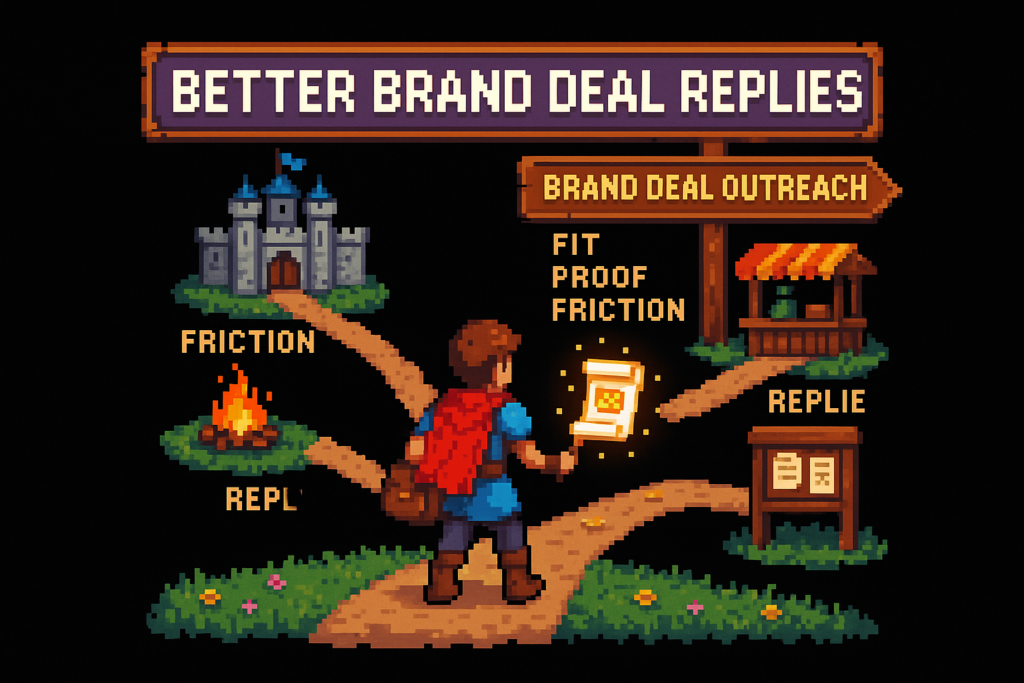
Brand deal outreach is the process creators use to start partnership conversations with brands through email, DMs, affiliate outreach, or marketplace deals. The best brand deal outreach path depends on audience fit, proof assets, and how much friction your ask creates for the brand.
You spent an hour writing a pitch, sent it to a dream brand, and heard nothing back. Meanwhile, another creator with a smaller audience landed a deal. The difference usually isn't luck. It's the outreach approach, the proof they lead with, and whether the ask fits the relationship.
It's normal to assume the problem is follower count. Usually, it isn't. More often, the issue is channel fit, pitch fit, or asking for too much too early.
This guide helps you choose the right brand deal outreach path, not just copy a template. If you want better replies, match your ask to the proof you already have.
Which brand deal outreach path fits your creator business
Cold outreach, warm outreach, affiliate-first outreach, and marketplace deals
There are four main ways creators start partnership conversations:
- Cold outreach: You contact a brand that doesn't know you yet.
- Warm outreach: You reach out after some prior connection, like tagging the product, getting a reply, or getting introduced.
- Affiliate-first outreach: You start with a lower-friction ask tied to product relevance and performance potential.
- Marketplace deals: You activate pre-available opportunities instead of pitching one brand at a time.
Each path changes control, speed, reply odds, and proof requirements. A simple decision lens helps: fit, proof, and friction.
- Fit: Does your audience clearly match the product?
- Proof: Can you show evidence that your content drives attention, clicks, or sales?
- Friction: How much effort and trust does the brand need before saying yes?
Here's the practical comparison:
| Outreach path | Best for | Proof needed | Reply likelihood | Speed to first deal | Ideal ask | Biggest downside |
|---|---|---|---|---|---|---|
| Cold outreach | Niche creators with strong audience alignment | Content examples, audience fit, one clear proof point | Lower | Medium to slow | Product sample, affiliate test, small campaign | More rejection, more targeting work |
| Warm outreach | Creators with prior brand touchpoints | Prior interaction, content mention, audience proof | Higher | Medium | Paid post, affiliate partnership, campaign discussion | Harder to scale if you don't create warm touchpoints |
| Affiliate-first outreach | Creators already recommending products | Clicks, saves, comments, conversion potential | Medium to high | Fast | Affiliate partnership, elevated commission, sample | Lower upfront cash than a paid sponsorship |
| Marketplace deals | Creators who want faster monetization on products they already feature | Content-product fit, monetization readiness | Highest for activation, since no pitch is required | Fastest | Activate available deal | Less customization than direct relationship building |
Choose based on your current proof:
- Go cold if your niche is tight and you can make a very specific case.
- Go warm if the brand has already seen your content or engaged with you.
- Go affiliate-first if you already talk about the product category and need an easier first yes.
- Go with Marketplace if you want lower-friction monetization while building your direct outreach system.
You've probably seen this play out: a creator with 8,000 YouTube subscribers sends generic sponsorship asks to big household brands and gets silence. Then they switch. They start with affiliate partnership outreach for products already featured in tutorials, and they save direct sponsorship emails for brands with obvious audience overlap. Reply quality improves because the ask finally matches the proof.
Myth: You need a huge following to do brand deal outreach.
Reality: You need audience fit, relevant proof, and a clear ask more than raw size.
Traditional outreach still matters because it gives you more control over the relationship. But Marketplace deals can shorten the path between product mention and revenue, especially if you're already using Amazon Associates and want a faster monetization layer.
Email outreach vs DM outreach
Channel choice changes friction. Lower-friction channels can start conversations. Higher-context channels usually close them.
DMs work best when context already exists. Maybe you tagged a product in a Reel, replied to a brand's Story, or got a quick response after mentioning them in a TikTok. In that case, a DM doesn't feel random. It feels timely.
Email works better when the ask needs documentation. If you're discussing a campaign brief, usage rights, audience demographics, deliverables, or a rate card, email gives both sides room to review details clearly.
For example, a TikTok creator might get a skincare brand's attention by replying to an Instagram Story after already featuring the cleanser in a routine video. The brand answers in DMs. Once pricing, content usage, and posting dates come up, the conversation moves to email. That's normal. DMs open the door, email handles the deal.
Here's the shorthand:
| Channel | Best for | Strength | Weakness |
|---|---|---|---|
| DM | Warm contact, quick touchpoints, follow-up after a mention | Fast, casual, easy to start | Harder to organize terms and proof |
| Sponsorship asks, proposals, campaign details | Professional, searchable, better for attachments | Higher friction if the brand doesn't know you |
Myth: DM outreach is less professional, so brands won't take it seriously.
Reality: DMs can work very well when the contact is warm and the ask is small. They just aren't the best place to negotiate usage rights or review a media kit.
Most creators don't need more channels. They need the right channel for the ask they're making.
How to choose the right outreach approach
By creator stage, audience size, and proof assets
This is where fit, proof, and friction become useful. Don't choose an outreach path based on what sounds impressive. Choose based on what you can support today.
A beginner creator with 2,000 followers and no paid campaigns can still have strong proof. Maybe their engagement rate is high, their audience demographics are tight, and their product posts get saves and comments. That's enough for a smaller ask. It usually isn't enough for a cold pitch asking for a three-video paid package.
Likewise, a blog creator with modest traffic but strong affiliate clicks in a narrow niche is often a better fit for affiliate-first outreach than for a cold one-off sponsorship ask. A larger lifestyle creator with a polished media kit, audience screenshots, and past campaign examples may do better with warm outreach or direct sponsorship pitches.
Use this matrix as your starting point:
| Creator stage | Audience size | Proof assets | Best outreach path | Likely first ask |
|---|---|---|---|---|
| Beginner | Small but engaged | Content examples, comments, saves, niche clarity | Affiliate-first or Marketplace | Affiliate link, product sample, small test |
| Beginner | Small and broad | Limited proof, weak niche fit | Marketplace first | Activate relevant deals, build proof |
| Growing | 5K to 50K or steady blog traffic | Media kit, engagement rate, affiliate clicks | Cold or warm outreach, plus affiliate-first | Affiliate partnership, one-off sponsored post |
| Established | Larger audience or strong traffic base | Past brand work, screenshots, audience demographics, rate card | Warm outreach and direct sponsorship pitches | Paid package, recurring partnership |
| Any stage | Strong product performance data | Clicks, conversions, repeat mentions | Affiliate-first | Elevated commission, quarterly test |
Myth: More pitches means more deals.
Reality: Better targeting usually beats volume. Ten random emails create more noise than five sharp pitches built around real audience fit.
Here's what actually works:
- Pick one outreach path for the next 30 days.
- Match your ask to your strongest proof asset.
- Keep the first ask smaller than your long-term goal.
If you're still building your proof package, the guides on creator monetization and outreach templates will help tighten the basics before you send anything.
By partnership goal, one-off sponsorship or long-term brand partnership
Your partnership goal changes the proof threshold. Bigger asks create more friction, so your proof has to do more work.
A one-off sponsorship ask is simpler. You're proposing a single post, video integration, or short campaign. This works well when the brand needs a quick activation or when you're testing fit.
A long-term brand partnership is a bigger commitment. Now the brand has to believe you can deliver consistently, represent the product well, and justify ongoing spend. That's where past results, usage rights clarity, and sometimes an exclusivity clause start to matter.
A common mistake is asking for the full relationship before earning the first yes. For example, a creator might pitch a paid three-video package before ever mentioning the brand in content and get ignored. Later, they open with an affiliate partnership ask tied to an existing review, generate sales proof, and use that performance to pitch a quarterly paid partnership. Same creator, better sequencing.
Compare the two asks:
| Partnership goal | Best for | Proof threshold | Mention rate card? | Mention usage rights? | Mention exclusivity? |
|---|---|---|---|---|---|
| One-off sponsorship | Testing fit, first paid campaign | Moderate | Yes, if asked or if the ask is clearly paid | Yes, if content reuse is involved | Only if the brand raises it |
| Long-term partnership | Ongoing ambassador or recurring campaign | Higher | Usually yes | Yes | Yes, if category lock-in matters |
Myth: Brand deals are separate from affiliate partnerships.
Reality: Affiliate and sponsorship outreach often belong in the same pipeline. A lower-friction affiliate relationship can become your best proof for a larger paid partnership later.
If you need message structure for either path, start with the outreach templates guide and use it to adjust the ask, not just the wording.
The goal isn't more pitches. It's better asks that match the relationship stage.
What to prepare before you send outreach
The minimum proof package, media kit, audience proof, and content examples
Most creators miss this step: brands don't need a perfect deck, they need quick proof that your audience is a match.
A simple one-page media kit is enough to start. It doesn't need fancy design. It needs clarity. Think of it as a proof package, not a portfolio project.
If you don't have past sponsorships, use what you do have: affiliate clicks, save rate, watch time, screenshots of comments asking about products, and examples of content where you already talk about the category.
A creator without paid partnership history can still look credible. Say you run a niche home office channel. Your desk setup videos get strong watch time, viewers ask where products came from, and affiliate links on similar items already get clicks. Put those signals on one page and the outreach instantly feels more grounded.
Use this checklist before you send anything:
| Asset | Minimum version | Why it matters |
|---|---|---|
| Media kit | One page with bio, niche, audience stats, content examples | Gives the brand quick context |
| Audience demographics | Platform screenshots or summary | Shows fit beyond follower count |
| Engagement rate | One or two relevant metrics | Proves audience attention |
| Content examples | 2 to 4 strong posts, videos, or articles | Shows how you feature products |
| Clear ask | One sentence | Reduces confusion and back-and-forth |
| Optional rate card | Simple pricing sheet | Helps once paid scope comes up |
| Optional campaign brief response | Notes on deliverables and timing | Useful for active negotiations |
Outreach with a media kit usually gets cleaner replies because the brand doesn't have to ask basic questions. Outreach without one can still work, but then the email has to do more of the heavy lifting.
Myth: A media kit has to be polished and fancy.
Reality: A simple, relevant one-page kit beats a beautiful deck full of vague stats.
For a stronger starting point, build your proof asset with this creator media kit guide.
What changes by outreach type
The prep work shifts depending on the path.
For cold outreach, targeting matters most. You need a sharp reason for contact: why this brand, why now, and why you. Generic praise won't carry the message.
For warm outreach, continuity matters most. Reference the prior interaction, product use, or mutual contact so the message feels like the next step, not a reset.
For affiliate-first outreach, relevance matters most. The product should already fit your content. Your proof can be lighter if the ask is smaller and tied to performance.
For Marketplace deals, the pitch requirement drops. You still need content fit and monetization readiness, but you don't need a full sponsorship proposal to test whether your audience buys.
Here's a realistic example. A creator already links to Amazon products in blog posts and YouTube descriptions. Instead of building a full paid sponsorship pitch from scratch, they activate relevant marketplace deals through Lasso's creator marketplace on products they already recommend. That gives them faster earnings data. Later, they use those results to decide which brands are worth pitching directly.
This is where traditional pitching and Marketplace differ most:
- Traditional outreach gives you more customization and relationship depth.
- Marketplace deals reduce application friction and can help you monetize faster.
- Amazon Associates still stays in the mix. Marketplace complements it, it doesn't replace it.
Myth: Cold outreach never works.
Reality: It works when the ask matches your content, audience, and proof. It fails when creators send broad sponsorship proposals with no clear fit.
If you already recommend products, you may not need to start with a cold pitch at all.
Brand deal outreach examples that match each path
Cold outreach email example
This format works because it leads with fit and proof, then keeps the ask small.
A home office creator might email a desk accessory brand after two setup videos perform well. Instead of asking for a large paid package, they ask for an affiliate partnership or product sample tied to content already published.
A template you can adapt:
Hi [Brand Name]
I recently featured ergonomic desk setups on my YouTube channel, and two recent videos drove strong engagement from remote workers building home offices. My audience is mostly 25 to 44 professionals in the US, and desk accessory recommendations consistently get high click interest. I'd love to explore an affiliate partnership or sample-based collaboration for your [specific product]. If helpful, I can send a one-page media kit with audience demographics and recent content examples.
Best,
[Name]
What not to do:
- Open with generic praise like "I love your brand"
- Include a long bio
- Ask vaguely to "collaborate"
- Jump straight to a large paid package without proof
For more copy-and-adapt examples, see outreach templates and the creator media kit guide.
Warm outreach and follow-up example
Warm contact lowers trust friction. Follow-up lowers timing friction.
If the brand didn't give a timeline, wait 5 to 7 business days before following up. That's enough time to be respectful without letting the thread die.
Picture a skincare creator who already tagged a brand in a routine video. The post gets strong audience questions about the serum, and the creator has screenshots of those comments. Their follow-up doesn't need to reintroduce everything. It just needs to connect the dots.
A concise follow-up example:
Hi [Brand Name]
Following up on my note from last week. I recently featured [product] in my routine, and the post sparked a lot of audience questions about it. I attached a few screenshots plus my media kit in case it's helpful. If you're open to it, I'd love to discuss either affiliate or paid partnership options that fit your current campaign goals.
Best,
[Name]
Warm outreach usually beats cold outreach on response likelihood because the brand has context. It also lets you write a shorter message, since you don't have to build trust from zero.
The difference between an ignored pitch and a reply is often one specific proof point and one respectful follow-up.
Marketplace deals as the no-application alternative
Direct pitching isn't the only way to start earning from product recommendations.
Lasso's creator marketplace offers no-application marketplace deals on products creators already promote. That matters if you want faster monetization without waiting on manual outreach. You still need content-product fit, but you don't need to send a custom pitch for each opportunity.
This works especially well for creators already using Amazon Associates. Marketplace doesn't replace it. It adds elevated commission opportunities on top of the products you're already recommending.
A YouTube creator in the kitchen niche is a good example. They mention tools in nearly every video but haven't built a sponsorship pipeline yet. Instead of waiting for brands to reply, they activate relevant deals through Lasso, earn higher commissions on those product mentions, and use the results to decide which brands deserve a direct pitch later.
Traditional outreach versus Marketplace usually comes down to this:
- Choose direct outreach if you want a custom relationship, campaign scope, or long-term brand partnership.
- Choose Marketplace if you want lower-friction earnings and proof you can build on.
- Use both if you want faster wins now and stronger negotiation leverage later.
If your broader goal is sustainable creator revenue, pair this with the creator monetization guide so your outreach strategy fits the rest of your income mix.
FAQ
What is brand deal outreach for creators?
It's the process creators use to start partnership conversations with brands through email, DMs, affiliate applications, or marketplace deals. The goal isn't just getting a reply. It's choosing the outreach path that fits your audience, proof, and partnership ask.
What should creators include in a brand deal outreach email?
Include five things: a specific product or brand reference, a quick explanation of audience fit, one proof point, a clear ask, and an optional media kit. Keep it short. Brands respond better to relevance than long introductions.
When should a creator send a follow-up after brand deal outreach?
Usually 5 to 7 business days after the first message, unless the brand gave a different timeline. Your follow-up should be brief, polite, and ideally add one useful detail, like a content example or audience response screenshot.
Do you need a media kit before reaching out to brands?
No, but even a simple one-page kit helps. It improves clarity, makes your pitch feel more credible, and saves time once a brand asks for audience demographics or content examples.
Should small creators do cold outreach for brand deals?
Yes, if the audience fit is strong and the ask is realistic. Smaller creators usually get better traction with lower-friction first asks, like affiliate partnerships, product samples, or a single sponsored placement instead of a large package.
What is the fastest way to start brand deal outreach if I have no contacts?
Affiliate-first outreach, targeted cold outreach, and Marketplace deals are the fastest realistic starting points. If you already recommend products, affiliate-first or Marketplace usually gets you moving faster than pitching a large paid campaign from scratch.
Is Lasso's creator marketplace better than pitching brands one by one?
It's different, not universally better. Marketplace is faster and lower friction, especially for products you already promote. Direct pitching gives you more customization, relationship depth, and room to shape a long-term brand partnership.
Can I use Marketplace and direct outreach at the same time?
Yes. That's often the smartest setup. Marketplace deals can generate earnings and proof while direct outreach helps you build custom partnerships with brands that are a strong fit for your audience.