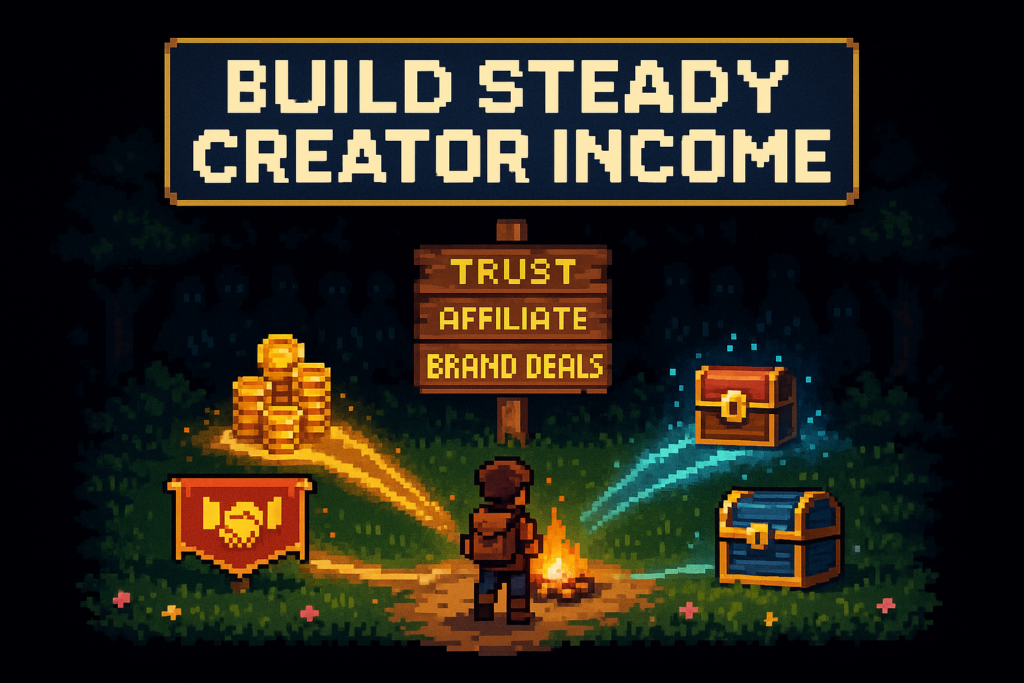
Creator monetization is the system creators use to turn audience trust and content into revenue through aligned income streams like affiliate links, brand deals, digital products, and marketplace offers. The goal is not to stack random income ideas. It is to build a revenue mix that fits audience intent and keeps working over time.
You publish, recommend products, answer DMs, and keep helping people, but the money still feels disconnected from the work. If that sounds familiar, you aren't lazy, late, or bad at business. You probably built trust before you built a revenue system.
That's normal. Many creators start with content, community, and useful recommendations, then add affiliate links, sponsored posts, or random brand partnerships later. The result is income that shows up, but rarely in a way you can predict.
Here's what actually works: treat creator monetization like an operating system. Start with trust, match revenue to intent, and build layers that keep working after the post goes live.
The creator monetization landscape
Why creator monetization feels disconnected at first
You've probably experienced this: your audience clearly trusts you, but your income doesn't reflect it yet. That gap shows up because trust usually comes before infrastructure.
Many creators start by publishing consistently, not by designing a business model. You share what you use, answer questions, and build a reputation for being helpful. Then later, you add a few Amazon links, say yes to a sponsorship, or test a product idea. None of that is wrong. But if each move happens in isolation, revenue feels random.
For example, a YouTube creator in the home office niche posts weekly desk setup videos and gets constant questions about chairs, monitors, and lighting. They add a few Amazon links in descriptions. A month later, they accept a generic wellness app sponsorship because the payout looks good. Money comes in from both, but neither path connects cleanly to what the audience already wants to buy.
That's the real issue. It usually isn't effort. It's misalignment between content, audience intent, and the path to revenue.
Myth: monetization starts after you get big.
Reality: it usually works better when you build it early around the trust you already have.
If your income still feels disconnected from your content, the fix usually starts with choosing the right revenue mix.
What sustainable creator income actually looks like
Steady creator income doesn't mean every month looks the same. It means your business isn't hanging on one sponsor reply, one algorithm shift, or one lucky post.
The strongest setup is repeatable, trust-preserving, and diversified. Usually, that means combining scalable income sources with selective higher-effort ones. Affiliate income keeps working across old and new content. Brand deals add premium upside when the fit is strong. Digital products can add margin once your audience starts asking the same questions over and over.
Picture a blog creator in the craft niche. Older tutorials keep earning small but steady commissions from product recommendations. Then they add a few marketplace deals on products they already mention, which improves commission quality. After that, they accept only sponsored content that fits the same categories readers already expect. No single stream carries the whole business, but together they create a steadier monthly baseline.
Myth: more monetization always means more revenue.
Reality: too many mismatched offers can weaken trust and lower conversions.
Before you add more offers, it helps to understand what each revenue stream does best.
The main creator revenue streams, and what each one is best for
Affiliate income, the scalable base layer
Affiliate income works best when your content already drives product discovery or purchase intent. If people ask what you use, where to buy it, or which option you'd choose, you already have the raw material.
That's why affiliate marketing is often the first real system layer for creator monetization. It scales better than custom deal work because one useful recommendation can keep earning from old posts, new videos, email sequences, and link hubs. Amazon Associates is often the starting point because it's easy to add to recommendation-heavy content.
A TikTok creator posting "things I actually bought and use" videos doesn't need to wait for a sponsor to validate the niche. If viewers keep asking for links, that's the signal. Organizing those recommendations into trackable links or a Lasso Page turns existing interest into something measurable and repeatable.
Affiliate income also gets more meaningful when you improve the basics: placement, relevance, and commission quality. A buried link at the bottom of a description won't perform like a clear recommendation page tied to a high-intent topic.
Myth: affiliate income is too small to matter.
Reality: small commissions compound when your content archive keeps working.
Affiliate income usually works best as a base layer, not the whole plan.
Brand deals and sponsored content, the selective premium layer
Brand partnerships can pay more per placement, but they also ask more from you. There's outreach, negotiation, approvals, revisions, deadlines, and usually more pressure to perform.
That's why sponsored content works best when it fits what your audience already expects from you. The goal isn't to cram a sponsor into your content calendar. It's to choose deals that feel like a natural extension of what you already talk about.
For example, a productivity creator gets offered a flat-fee sponsorship from a generic app that doesn't match their audience. They pass. A few weeks later, they land a smaller partnership with a tool they've already mentioned organically in multiple videos. That second deal feels more natural, performs better, and gives them a stronger case for future renewals.
Brand deals matter, but they shouldn't be treated like the only serious path. They're less scalable than links because each one is custom work. The more dependent you are on them, the more often you have to restart the revenue cycle.
If you want help with execution, our guides on brand deal outreach and creator outreach templates can help.
If brand deals feel intimidating, remember this: they work best as one part of a broader system.
Digital products and owned offers, the margin layer
Owned offers give you more control and better margins, but they only work when there's a clear problem to solve. You don't need a course just because other creators have one.
Digital products fit best when your audience asks repeat questions, wants a shortcut, or needs a template they can use right away. That could be a checklist, swipe file, mini guide, spreadsheet, preset pack, or workshop.
A creator who constantly gets asked about their editing workflow doesn't need to invent a whole new business. They can package their checklist, folder structure, and editing template into a low-ticket download. It works because demand was visible before the product existed.
This is where many creators get ahead of themselves. They build first, then hope the audience wants it. Try this instead: watch for repeated questions, repeated friction, and repeated requests. That's usually where an owned offer makes sense.
The best creator monetization model isn't the one with the most options. It's the one that fits your audience's intent.
Marketplace deals, how higher commissions complement Amazon Associates
Amazon Associates is often the first affiliate layer, but it doesn't have to be the last. If you already recommend products through Amazon, marketplace deals can improve earnings on some of those same recommendations.
Here's the short version: marketplace deals are elevated commission offers on products you already promote. They complement Amazon Associates instead of replacing it. Standard links can keep earning through Associates, while activated deals can pay higher rates where available.
For example, a creator who already links to kitchen tools in blog posts and YouTube descriptions might assume the setup is done. Then they activate relevant deals through Lasso's creator marketplace and earn better commissions on some of the same products, without changing the recommendation itself.
That's the appeal. You aren't rebuilding your content strategy. You're improving the economics behind content that already has buying intent.
Lasso helps in two ways. First, it organizes your affiliate infrastructure, including links and recommendation assets. Second, Marketplace surfaces no-application deals, so you don't have to pitch each brand one by one. If you use social platforms more than a blog, Lasso Pages can turn those recommendations into cleaner monetized landing pages.
| Option | What it does | Best use |
|---|---|---|
| Amazon Associates | Easy starting point for product links | Basic affiliate setup |
| Marketplace deals | Higher commissions on selected products | Earnings lift on existing recommendations |
Myth: Amazon Associates is the full affiliate strategy.
Reality: it's often the starting layer, and better commission opportunities can improve the same content.
If you're already earning through Amazon, the next question isn't whether to replace it. It's where to improve it.
The Trust-to-Revenue Monetization Mix
Stage 1, validate trust before you optimize revenue
Start with signals, not assumptions. Clicks, saves, replies, product questions, and repeat topic demand tell you where trust already exists.
This is the first rule of the Trust-to-Revenue Monetization Mix: don't begin with payout type. Begin with audience behavior. If people repeatedly want help making a decision, you already have the foundation for creator monetization.
For example, a creator with 4,000 email subscribers notices that every packing guide gets strong click activity and direct questions about luggage, organizers, and travel accessories. That's enough proof to start with affiliate links and a curated recommendation page. They don't need to wait for a giant audience or a sponsor to tell them the topic has commercial intent.
Small audiences with strong intent often outperform larger passive ones. A niche skincare creator with 12,000 engaged followers who ask for routine swaps can monetize earlier than a broad entertainment account with ten times the reach and no buying behavior.
Myth: I need a large audience before monetizing.
Reality: relevance and intent matter more than follower count.
Once trust is visible, the next step is choosing the lowest-friction way to turn that intent into revenue.
Stage 2, build a repeatable base with scalable offers
After you know where trust lives, build around assets that can keep working. For most creators, that means affiliate links, recommendation pages, and evergreen content that solves a buying question.
Most creators miss this step: they chase more traffic before improving conversion. But if your top content already gets clicks, better organization can do more than another month of random posting.
A YouTube creator with dozens of gear videos turns scattered description links into organized Lasso Pages by category: cameras, lighting, audio, desk setup. Then they rewrite the top video descriptions with clearer calls to action. Revenue doesn't explode overnight, but it becomes easier to track, compare, and improve.
Tools matter here because manual link management gets messy fast. Lasso helps creators organize links, surface monetization opportunities, and keep recommendation assets cleaner across platforms.
A stable base gives you room to be more selective with premium opportunities.
Stage 3, layer in selective premium partnerships
Once you know which topics and products already drive clicks or sales, you're in a much better position to add sponsorships. You aren't guessing what your audience might care about anymore. You have evidence.
That changes how you approach brand partnerships. Instead of pitching dozens of companies, you can focus on the short list that already fits your audience behavior. Your outreach gets sharper because it's tied to proven interest, not vague enthusiasm.
For example, a creator sees that desk setup content consistently drives the most clicks and conversions. Rather than emailing every office brand they can find, they build a short target list around products already resonating with viewers. That makes the partnership conversation stronger from the start.
Myth: affiliate links and brand partnerships compete with each other.
Reality: they often work better together. Link performance can tell you which sponsors are worth pursuing, and sponsorships can amplify categories that already convert.
The strongest creator businesses don't choose one lane forever. They add layers in the right order.
Stage 4, diversify carefully so revenue compounds
Diversification helps when each stream supports the same audience promise. It hurts when you pile on random offers that don't belong together.
The goal isn't to collect income streams like trophies. It's to reduce dependence on one platform, one sponsor, or one commission source while keeping trust intact. Review your mix for three things: effort, predictability, and trust risk.
A creator keeps affiliate links as the baseline, adds a few marketplace deals to improve earnings, accepts two aligned sponsorships per quarter, and launches one small digital product tied to a recurring audience problem. Each stream has a role. One weak month in any single channel doesn't break the business.
Myth: I should wait until my content is bigger before building a monetization system.
Reality: early systems compound. Late systems create cleanup work.
Once you see creator monetization as a mix, choosing the next move gets much easier.
How to choose the right monetization path for your current stage
Use audience intent, not audience size, as the first filter
Follower count is easy to see, which is why creators overvalue it. Buying intent is quieter, but it's usually the better signal.
Product-led content often monetizes earlier than entertainment-led content because the audience is already in decision mode. Repeated questions, recommendation requests, and comparison behavior all signal that your audience wants help choosing.
For example, a niche skincare creator with modest traffic gets constant questions about routines, product swaps, and what to buy first. That creator may be a better fit for affiliate income and selective partnerships than a much larger general lifestyle account with weaker purchase intent.
Here's a simple matrix:
| Audience size | Audience intent | Best revenue path |
|---|---|---|
| Small | High | Affiliate links, recommendation pages, selective deals |
| Medium | High | Affiliate base, marketplace upgrades, targeted sponsorships |
| Large | Low | Broader brand work, audience development before heavier monetization |
Most creators miss this step: the right model starts with what your audience is already trying to do.
Match each revenue stream to effort, predictability, and trust risk
Different income sources solve different problems. Don't judge them by hype. Judge them by role.
Affiliate links usually have lower setup friction, better scalability, and lower trust risk when the recommendation is relevant. Brand partnerships have higher effort and less predictability, but stronger upside per deal. Digital products take more build effort, but give you more control. Marketplace deals can improve earnings efficiency on recommendation content you already have.
A creator deciding between pitching brands or improving old affiliate content reviews their top tutorials and sees they already drive clicks. That tells them to optimize the archive first, then use the performance data to decide which brand conversations are worth starting later.
| Revenue stream | Setup effort | Income predictability | Trust risk | Best-fit stage |
|---|---|---|---|---|
| Affiliate links | Low to medium | Medium to high | Low when relevant | Early to advanced |
| Brand deals | Medium to high | Low to medium | Medium if mismatched | Mid to advanced |
| Digital products | High upfront | Medium | Low to medium | Mid to advanced |
| Marketplace deals | Low to medium | Medium to high | Low when aligned | Early to advanced |
Once you compare streams side by side, the next best move usually becomes obvious.
A simple decision checklist for your next monetization move
If you're stuck, use this checklist before adding anything new:
- Does my audience already ask for this?
- Can this revenue stream scale beyond one post?
- Would this recommendation still feel helpful if no one paid me?
- Am I trying to solve for cash now, or predictable monthly revenue?
- Do I have proof this topic converts attention into action?
A creator gets tempted by a one-off sponsorship with a decent flat fee. After running through the checklist, they realize the product doesn't fit their niche, won't help future content, and won't create repeat revenue. So they pass, improve affiliate placements on their highest-intent content, and revisit sponsorships later with better category proof.
Myth: brand deals are the best income source for every creator.
Reality: the best option depends on fit, repeatability, and what your audience already trusts you for.
If your next move is improving affiliate earnings, higher-commission deals can be the fastest upgrade.
Common creator objections
I need a large audience before monetizing
You don't. Brands and affiliate programs care about relevance and conversion quality, not just reach.
A micro creator in the camping niche may get fewer views than a broad lifestyle channel, but their gear recommendations can drive more clicks because the audience is actively shopping. Early creator monetization also teaches you what converts before scale arrives, which makes future growth more valuable.
Monetization will hurt audience trust
Trust usually drops when the offer is a bad fit, not because money is involved. Clear disclosure and strong alignment protect credibility.
If you recommend a tool you've used for months, explain why it helps, and disclose the commission relationship, most audiences respond well. Helpful recommendations often strengthen trust because they solve real problems. The FTC endorsement guidelines are the baseline for clear disclosure.
Affiliate income is too small to matter
It can feel small when links are scattered, buried, or tied to weak products. It gets more meaningful when content compounds and the setup improves.
A creator with dozens of old tutorials updates links, improves recommendation pages, and activates marketplace deals where available. The archive starts pulling more weight, and monthly earnings rise without needing a flood of new content.
If you want proof, browse the case studies. They're useful when you want examples of what optimization changes in practice.
Brand deals are the only serious creator revenue stream
They're valuable, but they aren't the only path to meaningful income. In many cases, scalable affiliate revenue creates a steadier base than sporadic sponsorships.
A creator who used to chase only sponsorships starts treating affiliate content as the baseline and uses brand work as selective upside. Over the next quarter, revenue becomes less erratic because not every dollar depends on a custom campaign.
I already use Amazon Associates, so there is nothing else to optimize
Amazon Associates is often the starting layer, not the finished system. Commission quality, link organization, and marketplace deals can all improve results.
A creator assumes their setup is done because links are already live. Then they review top-performing content and find products with better deal potential, weak calls to action, and pages that need a clearer path from interest to click. There was upside hiding in the existing archive.
I should wait until my content is bigger before building a monetization system
Waiting delays learning. It also creates a mess later.
One creator postpones setup for a year, then has to retrofit hundreds of posts and video descriptions. Another starts small, organizes links early, and builds cleaner systems as traffic grows. The second creator usually has an easier time turning growth into revenue because the foundation is already there.
FAQ
What is creator monetization?
It's a repeatable system for turning content, audience trust, and buying intent into revenue through aligned income streams. That can include affiliate links, brand partnerships, sponsored content, digital products, and higher-commission marketplace deals. The strongest setup protects trust while making income more predictable.
How do creators monetize without a huge audience?
They focus on niche relevance, audience intent, and trust. A smaller audience that asks for recommendations and acts on them often monetizes better than a larger audience that watches passively. That's why product-led niches can start earning earlier than many creators expect.
What are the main creator revenue streams?
The main options are affiliate income, brand deals, sponsored content, digital products, and marketplace deals that improve commissions on products you already promote. Each one plays a different role. Some scale better, some pay more per placement, and some give you more control.
What is the difference between affiliate income and brand deals for creators?
Affiliate income is usually more scalable and repeatable because links can keep earning across old and new content. Brand deals usually pay more upfront, but they require more custom work and are less predictable month to month. Many creators do best when they use affiliate revenue as the base and sponsorships as selective upside.
Can creators use Amazon Associates and marketplace deals together?
Yes. Marketplace complements Amazon Associates rather than replacing it. Standard links can keep earning through Associates, while activated marketplace deals can pay higher commissions on selected products where those offers are available.
How long does it take to start earning from creator monetization?
Affiliate earnings can start earlier than sponsorship income because you can add links to content that already exists. Brand deals usually take longer because they depend on outreach, fit, and negotiation. The timeline depends on your content intent, traffic quality, and how organized your setup is.
Do I need an Amazon Associates account before using Lasso?
For Amazon-focused affiliate workflows, yes. Amazon Associates is the starting layer. Lasso builds on that infrastructure by helping you organize links, improve monetized pages, and access marketplace deals that can raise commissions on relevant products.
What proof is there that optimizing links and commissions increases revenue?
The clearest proof comes from performance data and case studies. When creators improve link placement, organize recommendation assets, and activate better commission opportunities, earnings often increase because the same content converts more efficiently. Review current case studies for real examples and verified outcomes.