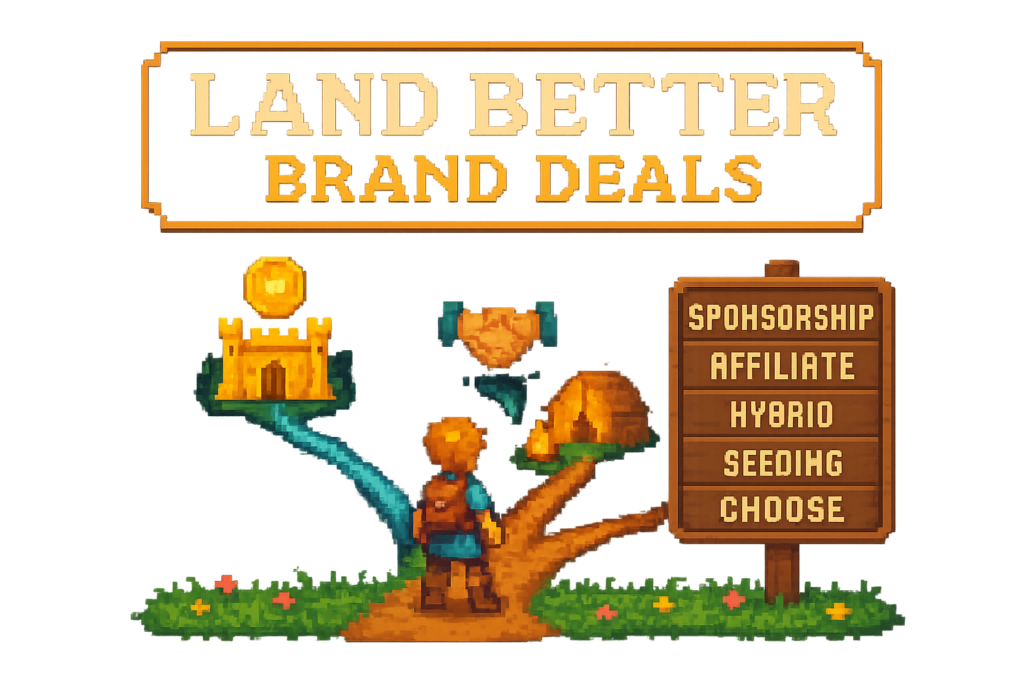
Brand deals for creators are partnerships where a company gives a creator money, product, commission, or a combination of all three in exchange for promotion, content, traffic, or sales. They can include direct sponsorships, affiliate partnerships, hybrid deals, marketplace offers, and product seeding. The structure of the deal determines how you price it, negotiate it, and measure whether it was worth doing.
You already recommend products. Then the offers start rolling in. One brand offers free product, another wants a dedicated video, and a third says they'll pay commission only. The hard part isn't finding monetization. It's figuring out what counts as a real partnership, and which offers are worth your time.
That confusion is normal. “Brand deal” gets used for everything from a gifted sample to a six-month paid campaign. Once you separate sponsorships, affiliate partnerships, product seeding, and hybrid deals, better decisions get much easier.
What counts as a brand deal for creators
The category is wider than most creators think. A paid Instagram post is one version, but it isn't the whole market.
A creator partnership usually means a company gives you money, product, commission, or some combination of all three in exchange for promotion, content, traffic, or sales. The structure matters because it changes how you price, negotiate, and measure the deal.
Direct sponsorships
A direct sponsorship is a one-to-one agreement between you and a brand. Usually, the brand sends a campaign brief that outlines the deliverables, timeline, talking points, approval process, and payment. This is the cleanest model when the company wants guaranteed content and you want predictable pay.
Common deliverables include a dedicated video, an integrated mention in a longer upload, a blog post, a newsletter placement, a social post, or a short-form clip. Sponsored content sits inside this bucket, but it's only one type of creator brand deal.
For example, a YouTube creator already mentions desk accessories in productivity videos. A keyboard brand reaches out asking for one dedicated review and one integrated mention in a future upload. The creator negotiates a flat fee, clarifies usage rights, and confirms there isn't a category-wide exclusivity clause that would block future keyboard partnerships.
That last piece matters more than newer creators realize. If a brand wants to reuse your video in paid ads or stop you from promoting competitors for 60 or 90 days, that's extra value they're buying. It shouldn't get bundled into the base content fee by default.
Myth: a brand deal always means a sponsored post.
Reality: direct sponsorships are just one branch of the category.
Compared with marketplace deals, direct sponsorships usually give you more room to negotiate. But they also require more back-and-forth, more contract review, and more setup time. If you want help starting those conversations, use this guide to brand deal outreach.
Affiliate and performance-based partnerships
Some creator sponsorship deals don't pay upfront at all. Instead, they pay based on tracked clicks, conversions, or sales. That's affiliate marketing, and yes, it can still count as a formal brand partnership when there's a real agreement, elevated commission, or structured program behind it.
This model doesn't replace Amazon Associates. Instead, it often sits on top of it. Amazon Associates is Amazon's standard affiliate program, and for many creators it's the base layer. Performance deals can improve the economics when a brand wants to reward actual sales instead of just buying content space.
We've seen this pattern in buyer-intent content. A blog creator ranks for “best air purifiers for allergies” and already sends steady clicks to Amazon. Instead of taking a one-time flat fee from one brand, they activate a higher-commission marketplace deal through Lasso's creator marketplace and earn more on ongoing sales from content that's already live. No new sponsored asset required.
That's the key tradeoff. Commission-only structures bring less guaranteed income, but they can outperform a one-off payment if your content keeps converting for months. Evergreen blog posts, YouTube reviews, gift guides, and comparison pages are where this tends to work best.
Myth: brand deals and affiliate marketing are completely separate.
Reality: there's a lot of overlap, especially when the partnership includes custom terms, elevated rates, or tracked performance.
If you already recommend products, marketplace deals can surface higher-commission offers on the same products you promote. For the broader income picture, see the creator monetization guide.
Product seeding and hybrid deals
Product seeding means a brand sends free product without guaranteed payment. Sometimes that's useful. Often, it's just a sample, not a paid collaboration.
That distinction matters because creators routinely get offered “exposure” packaged as a partnership. Free product has value if you genuinely want to test it, if it helps you evaluate fit, or if it gives you proof before pitching a paid package later. But it isn't the same as a sponsorship.
For example, a home organization creator gets offered free storage bins in exchange for coverage. Instead of treating that as paid work, they only accept if they actually want to test the product. If the product performs well with their audience, they use those results to pitch a follow-up package with a clear rate card, defined deliverables, and paid distribution.
Hybrid deals sit in the middle. That might mean a flat fee plus commission, gifted product plus a paid add-on, or a trial campaign that expands into a monthly retainer. For creators, this is often the healthiest structure because it covers production cost while keeping upside on the table.
Myth: free products are always a good starting deal.
Reality: they can make sense selectively, but they aren't a substitute for paid creator collaborations.
Most creators earn more when they can tell the difference between a sample, a sponsorship, and a real partnership.
Quick comparison of the main deal types
| Deal type | How payment works | Best fit | Tradeoff |
|---|---|---|---|
| Direct sponsorship | Flat fee, sometimes with bonuses | Custom content, fixed deliverables, short campaign windows | More negotiation and setup |
| Affiliate partnership | Commission on tracked sales or clicks | Evergreen, high-intent content that already converts | Less guaranteed income |
| Marketplace deal | Pre-structured elevated commission on relevant products | Creators already promoting Amazon products | Less custom negotiation, depends on available offers |
| Hybrid deal | Flat fee plus commission or bonus | Proven fit with real production effort | More moving parts to define |
| Product seeding | Free product only | Testing fit, product evaluation, proof gathering | Not paid work |
A simple way to choose: use direct sponsorships for custom work, performance deals for evergreen content, hybrid deals when you want both protection and upside, and product seeding only when the sample itself is useful.
How brand deals work, from first contact to payment
The workflow is usually simpler than it looks: fit first, terms second, payment structure third.
The creators who struggle most with partnerships usually don't have a talent problem. They have a process problem.
Step 1, the brand or creator spots a fit
Deals start with audience fit, product relevance, and content format alignment. If those three pieces aren't there, nothing else really matters.
There are three common entry points: inbound outreach from a brand, cold pitching from the creator, and marketplace discovery. Marketplace deals reduce friction because the terms are often pre-structured, which means less time spent negotiating from scratch.
A practical example: a creator who posts budget home office setups notices one of their top-linked products has a marketplace deal available inside Lasso. Instead of pitching cold, they activate the deal because the product already fits their audience and content library.
Direct outreach still has a place, especially if you want custom packages or long-term paid partnerships. But if the product is already in your stack and the economics are better, a marketplace path can be faster.
If pitching still feels awkward, start with these creator outreach templates.
Step 2, both sides define deliverables and terms
Once there's a fit, the real work starts. This is where a campaign brief matters.
A good brief covers the content type, timeline, talking points, links, disclosure requirements, revision limits, and approval flow. It should also spell out usage rights and any exclusivity clause. Usage rights are the brand's permission to reuse your content in ads, email, landing pages, or product pages. An exclusivity clause restricts you from promoting competing products for a set period.
For example, a skincare creator might get offered $400 for one Reel. Sounds straightforward until the contract also asks for 90 days of paid ad usage and category exclusivity. Once the creator separates the content fee from the added rights and restrictions, the original offer stops looking reasonable.
That's why your rate card should frame more than just “one post equals X.” It should help you break apart the asset, the licensing, and the restrictions. More rights and tighter restrictions should mean more compensation.
Pricing gets much easier once you know exactly what the brand is buying. If you need help with that part, read this guide on how to price brand deals.
Step 3, the creator publishes and gets paid
After terms are locked, the creator publishes, tracks performance, and gets paid based on the agreed model. That could be a flat fee, commission, hybrid payout, or product-only arrangement.
Affiliate-style partnerships often pay over time because earnings depend on tracked sales. Before anything goes live, confirm payment timing, reporting cadence, and link tracking. If the deal depends on performance, you need to know how that performance will be measured.
A YouTube creator might post a sponsored desk setup video with tracked links in the description and a Lasso Page in bio. The flat fee covers production. The affiliate component keeps earning as viewers keep shopping from the video over the next few months.
That's the bigger point. One-off payout is fine. Long-tail earnings are better when the content has shelf life.
For disclosure rules, review the FTC endorsement guides. For baseline affiliate program terms, see Amazon Associates.
Common deliverables and payment models
| Content format | Common payment model | Best-fit scenario |
|---|---|---|
| Dedicated YouTube video | Flat fee or hybrid | High production effort, strong brand control needs |
| Integrated YouTube mention | Flat fee, hybrid, or commission | Natural fit inside existing content format |
| Blog post or product roundup | Commission, marketplace deal, or hybrid | Evergreen search traffic and buyer intent |
| Newsletter placement | Flat fee or affiliate split | Engaged email audience with strong click behavior |
| Instagram Reel or TikTok | Flat fee, sometimes hybrid | Short campaign window, custom creative ask |
| Link-in-bio or resource page | Commission or marketplace deal | Ongoing product recommendations across social |
The signals that help creators qualify for better brand deals
Brands don't buy follower counts in a vacuum. They buy fit, trust, and the odds that your audience will actually care.
That's why smaller creators often do better than they expect, and broad creators often do worse.
Audience fit matters more than follower count
A creator with a narrow niche and clear buying intent can be more valuable than someone with ten times the audience and weak relevance. This is one of the biggest myths in creator monetization.
For example, a creator with 8,000 YouTube subscribers who posts detailed coffee gear reviews may be far more attractive to a coffee brand than a general lifestyle creator with 80,000 followers. Why? Because the audience already asks where to buy grinders, kettles, and espresso tools. The trust is specific.
Strong signals include repeat product mentions, comments asking for recommendations, affiliate link clicks, saves, replies, and email engagement. Those behaviors tell a brand your audience doesn't just watch. They act.
Myth: only large creators get deals.
Reality: niche relevance and audience trust often beat raw audience size.
Your audience trusts you because your recommendations already solve a problem for them.
Proof brands actually care about
A creator media kit helps. Recent content examples help. Audience demographics help. But the strongest proof is usually evidence that your audience takes action.
That can include click data, sales proof, screenshots from Amazon Associates, strong reply rates on product emails, or examples of past content that drove meaningful engagement around a product category. A rate card helps frame pricing, but proof of fit usually matters first.
For example, a blog creator pitching a cookware brand might include screenshots showing steady clicks on existing pan recommendations, plus a media kit highlighting a meal-prep audience. That pitch lands differently because it shows buying behavior, not just traffic volume.
Myth: more pitches automatically lead to more deals.
Reality: better-fit outreach backed by proof usually wins.
The goal isn't more pitches. It's better ones backed by evidence. If you're building that system now, start with this brand deal outreach guide.
Red flags and green flags in brand offers
Some offers are bad on arrival. You don't need to negotiate every one of them.
A supplement brand asking for three videos, six story frames, perpetual usage rights, and a 30-day turnaround for a small flat fee is showing you the shape of the relationship upfront. If the scope is bloated and the terms are vague, the deal usually doesn't improve later.
Here's what to screen for:
| Red flags | Green flags |
|---|---|
| Vague deliverables | Clear campaign brief |
| Unlimited revisions | Defined revision limits |
| Broad usage rights with no added fee | Usage rights spelled out and priced separately |
| Category exclusivity with a low fee | Restrictions matched to compensation |
| No payment timeline | Transparent payment terms |
| Pressure to post fast | Realistic production timeline |
| Commission-only offer with weak audience fit | Strong product alignment and room to negotiate |
Knowing what to decline is part of landing better deals, not missing opportunities.
How to choose the right type of brand deal
The best structure depends on two things: how much work the content requires, and how predictable the performance is.
If you get this wrong, you either undercharge for production or give away upside on content that could keep earning.
When a flat-fee deal makes sense
Flat-fee sponsored content is usually the right call when the work is custom, time-heavy, or hard to forecast on performance alone. If a brand wants a dedicated asset, tight messaging control, or a short campaign window, guaranteed pay protects your margin.
For example, a creator asked to film a custom tutorial featuring a niche kitchen appliance shouldn't rely on commission alone to cover scripting, setup, filming, and editing. The production effort is real whether the product converts or not.
This is also where a rate card helps anchor the conversation. Not because every project should be fixed-price, but because it gives you a baseline for the labor involved.
If the work is custom and time-heavy, guaranteed pay usually protects your margins.
When a performance deal makes sense
Performance-based creator partnership deals work best when the content is evergreen, buyer intent is already strong, and the product is something you'd recommend anyway.
A creator with an older “best webcams for Zoom” article that still gets traffic every week has a strong case for a marketplace deal or affiliate partnership. The content already exists. The audience is already shopping. Better commissions can outperform another one-time campaign.
This is where marketplace is useful. Lasso's creator marketplace surfaces elevated commission deals on products you already promote, without requiring you to apply to each one individually. It complements Amazon Associates rather than replacing it.
If you're already driving clicks, better commissions can matter more than another one-time campaign.
When a hybrid deal is the best option
Hybrid structures are often the most creator-friendly because they match how value is actually created. You do real production work upfront, and if the content keeps converting, you share in that upside.
For example, a YouTube creator agrees to one paid integration plus a commission bump on tracked sales for 60 days. The flat fee covers production. The performance layer rewards them if the video keeps moving product after launch.
Use this checklist:
| If this is true… | Best structure |
|---|---|
| The content is custom and labor-heavy | Flat fee |
| The content is evergreen and already converts | Performance |
| The content requires real production and has strong sales potential | Hybrid |
| The brand wants broad usage rights or exclusivity | Higher flat fee, often with add-on licensing |
| The offer is product-only | Treat it as seeding, not paid work |
Hybrid deals often create the healthiest balance between predictable income and upside.
FAQ
What are brand deals for creators?
They're partnerships where a company gives a creator money, product, commission, or some combination of those in exchange for promotion, content, traffic, or sales. That can include sponsorships, affiliate partnerships, marketplace deals, hybrid offers, and sometimes product seeding.
How do brand deals work for creators?
The usual flow is simple: a brand or creator spots a fit, both sides agree on terms and deliverables, the content goes live, and payment follows the agreed model. Some deals are direct and custom. Others, like marketplace deals, are more pre-structured and faster to activate.
What is the difference between a brand deal and affiliate marketing?
Affiliate marketing is a payment model based on tracked performance. A brand deal is the broader category. Some partnerships are flat-fee sponsorships, some are commission-based, and some combine both. So affiliate marketing can be one type of creator partnership, not a separate universe.
Do you need a large audience to get brand deals?
No. Niche relevance, audience trust, and proof of buying intent usually matter more than raw follower count. A smaller creator with clear product fit often has a better pitch than a larger creator with a broad, low-intent audience.
How much do brand deals pay creators?
Pay varies based on platform, niche, deliverables, production effort, audience fit, usage rights, exclusivity, and whether the deal is flat-fee, performance-based, or hybrid. A simple integrated mention and a dedicated video with ad licensing shouldn't be priced the same. For specifics, see how to price brand deals.
What should creators charge for a sponsored post or video?
Start with the production work, then add for business value, usage rights, and any exclusivity. The cleanest approach is to separate the content creation fee from licensing or restriction fees whenever possible. That keeps you from underpricing deals that include extra rights.
Should creators accept commission-only brand deals?
Sometimes, yes. They can make sense for evergreen, high-intent content or products you already recommend and know will convert. They usually make less sense for custom production work, tight deadlines, or campaigns with heavy brand control. If you want a lower-friction performance option, marketplace deals are often a better place to start.
Can creators use Lasso's Marketplace instead of pitching brands directly?
Yes, but it's best viewed as a complement, not a total replacement. Marketplace gives creators access to higher-commission deals on relevant products without applying to each one individually. Direct outreach still makes sense when you want custom sponsorships, broader packages, or long-term paid collaborations.