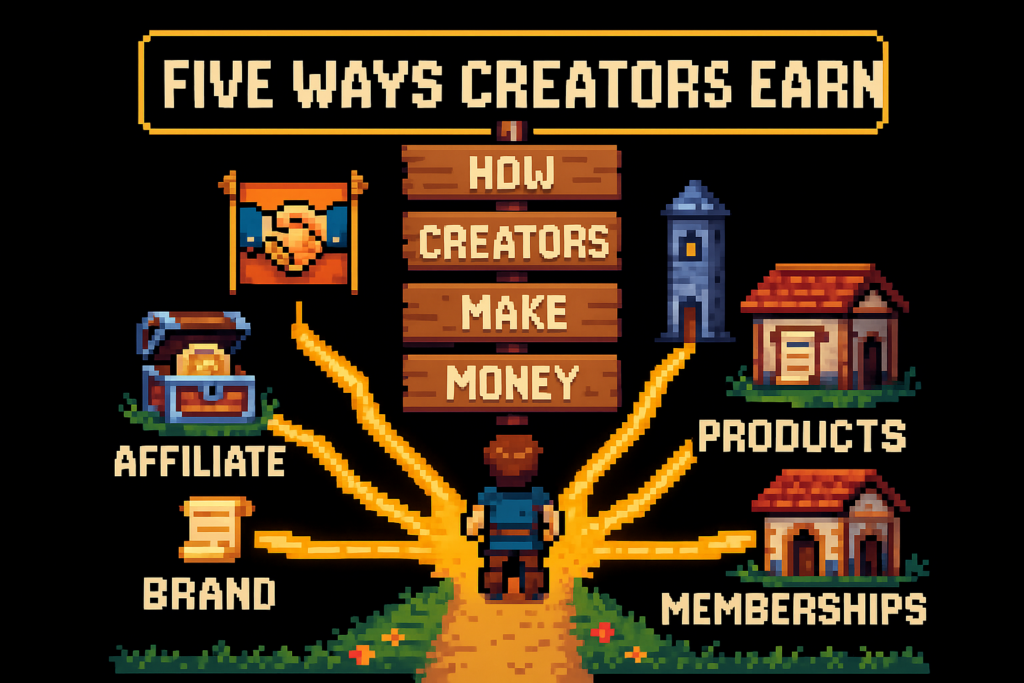
Creator monetization is how creators turn audience attention into income through models like affiliate links, brand partnerships, ad revenue, digital products, and memberships. The best path usually depends less on follower count and more on trust, content format, and whether your audience already acts on your recommendations.
You post consistently, your audience replies, and people keep asking where you got that product, tool, or setup. That’s usually the first sign your content is already monetizable, even if your following still feels small.
A lot of creators assume they need huge reach before they can earn. Usually, they don’t. Trust, relevance, and buying intent matter more than raw follower count.
The real question isn’t whether creators can make money. It’s which income model fits the content they already make, and which one can grow into something stable instead of staying random.
How creators make money, the five core income streams
Creators usually make money through five income streams: affiliate income, brand partnerships, ad revenue, digital products, and memberships.
Each one comes with a tradeoff. Some are fast to start but less predictable. Others take more work upfront but give you more control later. That’s the real decision, not which model sounds best on social media.
Myth: creators only make money from ads.
Reality: many creators earn more from direct monetization and affiliate revenue than from platform payouts alone.
A simple way to think about it: start with one low-friction stream, then add one higher-control stream for stability.
A YouTube creator with 8,000 subscribers who reviews desk setups is a good example. They can add affiliate links to existing videos this week. Later, they can take a few sponsored integrations from brands that fit. After that, they might sell a Notion template pack to the same audience.
| Income stream | How it works | Setup time | Income predictability | Audience size needed | Trust risk | Best for |
|---|---|---|---|---|---|---|
| Affiliate income | You earn a commission when someone buys through your tracked link | Low | Medium | Low to medium | Low if recommendations are honest | Creators already recommending products, tools, books, gear, or software |
| Brand partnerships | A brand pays for sponsored content, usage rights, or ongoing promotion | Medium | Low to medium | Medium, but niche trust can beat size | Medium to high if fit is poor | Social-first creators with clear audience alignment |
| Ad revenue | Platforms share ad income or creator fund payouts based on views and watch time | Low | Low | Medium to high | Low | Video creators with strong view volume |
| Digital products | You sell templates, guides, courses, presets, or downloads directly | High | Medium | Low to medium | Low if the offer solves a real problem | Educational creators with repeat audience questions |
| Memberships | People pay recurring fees for access, community, content, or coaching | High | High once retention is healthy | Medium | Medium if value slips | Creators with loyal repeat audiences |
Compare the creator monetization guide and brand deal outreach strategies if you want help choosing between these paths.
Affiliate income
Affiliate income pays you a commission when someone clicks your tracked link and buys. Amazon Associates is a familiar starting point for many creators because it’s easy to understand and fits product-led content naturally.
This works especially well if your audience already asks what you use. Skincare, camera gear, books, software, kitchen tools, office setups, supplements, and baby gear can all fit.
A skincare creator is a clean example. People keep asking for cleanser and sunscreen links in the comments. Instead of waiting for a sponsor, they add affiliate links to products they already mention. Later, they can replace some standard links with higher-paying marketplace deals through the creator monetization guide without changing the content angle.
Myth: affiliate links only work for creators with massive traffic.
Reality: smaller creators often convert better because the audience trusts the recommendation more.
If you’re already recommending products, you may be closer to affiliate income than you think.
Brand partnership income
Brand partnerships are paid relationships between a creator and a company. Sponsored content is the most common format: a reel, video segment, post, newsletter placement, or a package of deliverables tied to a campaign.
Payment structures vary. You might get a flat fee, a commission, gifted product plus a fee, or a longer-term ambassadorship. The upside is obvious: brand partnership income can land faster than affiliate commissions. The downside is that it’s less evergreen and less predictable.
A niche fitness creator with 12,000 followers might outperform a generic lifestyle account with 100,000. If their audience saves workouts, asks detailed supplement questions, and buys what they recommend, a supplement brand will care. That creator can get a paid reel because the response is measurable, not because the follower count looks impressive.
Myth: brand deals are the best first income stream.
Reality: they can pay well, but they usually come after you’ve shown audience response. For many creators, affiliate content is easier to launch first because it fits what they already publish.
If you’re leaning this way, brand deal outreach and outreach templates are the next practical reads.
Ad revenue and platform payouts
Ad revenue is money you earn from platform ad sharing, watch-page monetization, or creator funds. It sounds simple because the platform handles the mechanics. The problem is that the platform also controls most of the economics.
Views, watch time, RPMs, eligibility rules, and policy changes all affect what you earn. As a result, ads are useful, but they aren’t especially controllable. YouTube’s own YouTube Partner Program overview shows how eligibility and monetization rules shape payouts.
A creator gets one breakout video, sees a nice payout bump, and starts planning around that number. Next month, views settle back to normal and income drops with them. That’s common. Ad revenue can be a strong supplement, but it’s a shaky foundation if it’s your only stream.
Myth: more views automatically means stable creator income.
Reality: more views can mean more money for a while. Stability usually comes from adding revenue you control more directly.
If your income rises and falls with platform payouts, adding a direct revenue stream can smooth things out.
Digital product sales
Digital products are paid assets you create once and sell repeatedly: templates, courses, guides, swipe files, presets, downloads, calculators, or resource packs.
Margins are high because there’s no physical inventory. Control is strong because you set the price, the offer, and the positioning. The tradeoff is the upfront work. You need to know what your audience actually wants, not what you hope they’ll buy.
A budgeting creator who keeps getting asked for the same spreadsheet every week has a clear signal. Instead of sending the file manually in DMs, they package it into a paid template with a short tutorial. That turns repeated audience demand into a scalable offer.
This model works best when your audience wants an outcome, not just a product recommendation. If they want to implement what you teach, products make sense.
The strongest product ideas usually come from questions your audience already ask for free.
Memberships and subscription communities
Memberships are recurring paid offers. People subscribe for ongoing access to content, community, coaching, office hours, resource drops, or some mix of those.
The appeal is recurring revenue. A membership can be more stable than one-off sponsorships or launch-based product sales. But retention matters more than launch energy. If people don’t keep getting value, they leave.
A creator with a loyal newsletter audience might launch a small paid community with monthly office hours and curated resources. Even if only a small percentage joins, the monthly income can become more predictable than occasional sponsored posts.
Myth: more income streams always means more stability.
Reality: if every stream needs constant attention, you’ve built complexity, not stability. A well-run membership can help, but only if you can keep delivering something worth paying for.
Recurring revenue sounds appealing, but it only works when you can keep delivering something people want to stay for.
How to choose your first creator monetization model
Most creators don’t need more options. They need a cleaner first decision.
The easiest first model is usually the one that fits the content you already publish. Not the one that sounds most impressive. Not the one another creator in a different niche is posting screenshots about.
Think of it like picking the right container before you pour. If the fit is off, things get messy fast. Start with fit, then scale.
A new creator with a small but engaged audience might feel pressure to pitch brands right away. But if their content already includes product recommendations, affiliate links are often faster to test. A larger creator with strong repeat engagement may be ready for sponsorships or a membership instead.
| Creator stage | Best first revenue stream | Why it fits | Good second stream |
|---|---|---|---|
| Beginner | Affiliate income | Fastest to launch if you already recommend products | Digital product later |
| Growing creator | Brand partnerships or affiliate income | You have enough proof of audience response to test both | Digital product |
| Established creator | Digital products or memberships | Stronger trust and clearer audience demand | Selective sponsorships |
| Decision angle | Best option |
|---|---|
| Easiest to start | Affiliate income |
| Most controllable | Digital products |
| Most predictable over time | Memberships, if retention is strong |
Most creators miss this step: choosing a model that matches the content they’re already making.
Start with audience behavior, not follower count
Follower count is noisy. Audience behavior is signal.
Clicks, replies, saves, product questions, repeat comments, and DMs asking for exact links tell you much more about monetization potential than a vanity metric does. Audience trust shows up in actions.
A creator with 3,000 followers who gets frequent DMs asking for exact product links may monetize faster than a creator with 50,000 followers and weak buying intent. That’s not unusual. Niche trust often beats broad reach.
Myth: a big audience equals better monetization.
Reality: engaged niche audiences often earn sooner because they act on recommendations.
Your audience trusts you because your recommendations solve a real problem for them.
Match the model to your content format
Some monetization methods fit certain platforms more naturally.
Blog content and YouTube usually support affiliate links well because links live close to the recommendation. Educational content often supports digital products because the audience wants a repeatable outcome. Social-first creators may do better with sponsorships, memberships, or a monetized landing page setup, depending on how their audience behaves.
A YouTube creator can place affiliate links in descriptions and use a cleaner publishing workflow as their link volume grows. An Instagram creator may need a better off-platform destination so product interest turns into clicks without cramming everything into one bio link.
Here’s the system:
- If your content recommends products, start with affiliate links.
- If your content drives strong engagement and brands already notice, test sponsorships.
- If your content teaches a repeatable process, test a product.
- If your audience comes back for ongoing access, test a membership.
Try this instead: pick the revenue model that feels like a natural extension of the content, not an interruption.
Use a simple first-model checklist
You don’t need a giant strategy doc for this. You need a few honest signals.
Use this checklist:
- Do people already ask what you use?
- Can you recommend products naturally?
- Do brands already reach out, even occasionally?
- Does your audience want transformation or access?
- Can you maintain recurring delivery every month?
The pattern is usually clear:
- Product questions often point to affiliate income.
- Strong engagement plus niche fit often points to brand partnerships.
- Repeat how-to requests usually point to digital products.
- A loyal repeat audience can support memberships.
A creator who gets nonstop camera gear questions probably shouldn’t start with coaching. Another creator who keeps getting asked for a swipe file or template probably has a product opportunity.
Myth: you should launch multiple income streams right away.
Reality: one working revenue stream beats five half-built ones.
How to combine revenue streams without losing audience trust
Diversification helps, but only after one stream is working.
The mistake is stacking random monetization layers until every post feels like a checkout page. That’s not a business. It’s a trust leak. Your audience can feel when every recommendation has a price tag attached.
The cleaner progression is usually this: start with affiliate links, add brand deals or a product once you know what converts, then add a membership only if there’s real demand for ongoing access.
A creator starts with affiliate links in evergreen tutorials. Those tutorials keep driving clicks. Once the data is clear, they add a few well-matched sponsorships and later release a paid template pack. The audience experience still feels coherent because every offer supports the same topic.
The goal isn’t more monetization. It’s a cleaner mix your audience actually trusts.
Build around one evergreen stream
Evergreen revenue comes from content that keeps earning after publish day. That’s why affiliate content and some digital products make such strong base layers.
A setup video, buying guide, or tutorial can keep generating clicks and commissions for months. A template or download can keep selling long after launch week. By contrast, one-off sponsorship fees stop when the campaign ends.
A creator’s old desk setup video still drives clicks six months later. That ongoing affiliate revenue gives them breathing room. They don’t have to say yes to every sponsor that lands in the inbox.
Sustainable income usually starts with content that keeps earning after publish day.
Add one direct or higher-control stream
Once you know what your audience wants, add one stream you control more directly. Usually, that means digital products or memberships.
This is where pricing control matters. With affiliate commissions and sponsorships, someone else sets part of the equation. With your own offer, you control the packaging, price, and positioning.
A creator who earns commissions from software reviews later launches a paid template bundle that helps viewers implement the workflow. The affiliate income captures buying intent. The product captures deeper implementation intent.
The best second revenue stream usually gives you more control, not just another payout source.
Keep sponsored content selective
Sponsored content can fit well in a diversified creator business. It just can’t become the whole feed.
Too many mismatched partnerships weaken trust fast. The better move is to use audience data and affiliate performance to judge what actually fits. If people already click, ask about, or buy within a category, that’s a strong clue for future partnerships.
A creator turns down a high-paying deal for a product their audience has never asked about. A month later, they accept a smaller partnership that fits their niche and gets stronger engagement because the recommendation feels real. Short-term fee down, long-term trust up.
A pitch that feels authentic starts with audience fit, not the biggest fee.
FAQ
How do creators make money online?
Creators usually earn through affiliate links, brand partnerships, ad revenue, digital products, and memberships. The best fit depends on audience trust, content format, and whether you want one-time payouts or recurring revenue.
What are the main income streams for creators?
The five core creator income models are affiliate marketing, sponsored partnerships, platform ad payouts, digital product sales, and paid memberships. Some depend heavily on platform rules, while others you control more directly.
Do creators need a large audience to start earning?
No. Smaller niche creators often monetize earlier when their audience shows strong trust and clear buying intent. Product questions, clicks, replies, and saves matter more than follower count alone.
What is the difference between affiliate income and brand deals?
Affiliate income is commission-based. You earn when someone buys through your tracked link. Brand deals usually pay a flat fee or negotiated rate for sponsored content. Affiliate revenue can be more evergreen, while brand partnerships often pay faster upfront.
What is the easiest monetization method for a new creator to start with?
For most creators, affiliate income is the easiest first option because it fits content they already publish. If you already recommend products, tools, or gear, you can start testing links without building a new offer from scratch.
How long does it usually take for creators to earn meaningful income?
It depends on your niche, consistency, audience behavior, and the model you choose. Affiliate links can start generating early if your content already drives buying intent. Products and memberships usually take longer because you need to validate the offer first.
Do creators need tools to manage affiliate links and brand deals effectively?
Not at first, but tools get more useful as your content library grows. Link management, monetized landing pages, and publishing workflow support save time and reduce mess.
What should creators look for in a monetization platform or marketplace?
Look for five things: higher commissions, fit with your existing content, simple activation, clear tracking, and support for sustainable income. The best platform should help you earn more from content you already publish, not force a completely new workflow.