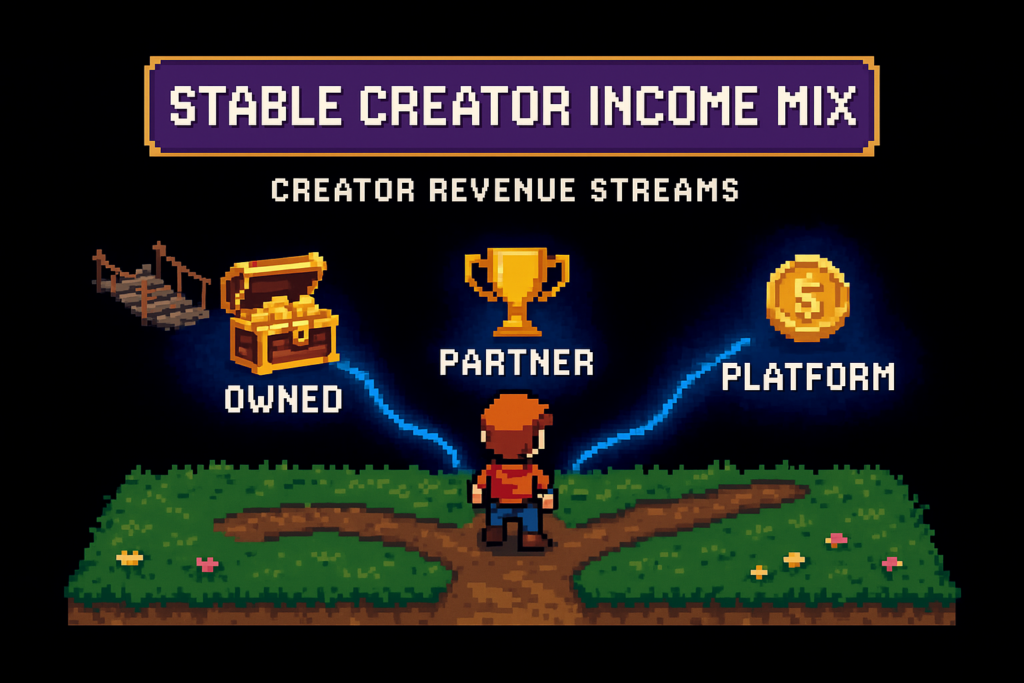
Creator revenue streams are the distinct ways creators earn income from their audience, content, and expertise. The three main categories are owned revenue, partner-based revenue, and platform-dependent revenue. A stable creator business usually comes from combining a few of these streams instead of relying on one payout source.
One month a sponsorship lands. The next month ad revenue dips. Then nothing replaces it.
That swing is normal, especially if most of your income comes from one platform, one sponsor, or one payout program. The fix usually isn't finding one perfect monetization channel. It's building a mix that fits your audience, your content, and the work you can actually maintain.
Think of it like a three-legged stool. If one leg is weak, the whole thing wobbles. A steadier creator business usually comes from combining a few different ways to earn, not betting everything on one.
Revenue stream categories every creator should understand
Owned revenue, income you control more directly
Owned revenue comes from assets you control more than a platform payout or one-off campaign. That usually means digital products, memberships, paid communities, templates, workshops, or a paid newsletter.
This bucket matters because it gives you better margin and more control over pricing, packaging, and positioning. If you sell a template pack for $29 or run a paid Substack tier, you aren't waiting for RPM changes or hoping a sponsor renews.
That said, "owned" doesn't mean risk-free. If your paid community lives on Patreon or your newsletter runs on Substack, you're still relying on another platform for delivery. You control the offer more than the platform rules.
For example, a newsletter creator with 4,000 loyal readers might launch a paid Substack tier with monthly Q&A posts, niche templates, and one teardown each month. They don't need millions of views. They need a clear promise and readers who already trust their advice.
Compare that to platform revenue. With owned offers, you can shape the product, price, and cadence. With platform payouts, the platform shapes more of the economics.
Myth: You need a huge audience to build multiple revenue streams.
Reality: Small, trusted audiences often monetize faster through niche offers than broad audiences do through generic content.
If you're already building around recommendations, affiliate income can add a second stream without forcing you to invent a whole new product. For a bigger planning view, see the creator monetization guide.
Partner-based revenue, income earned through brands and affiliate relationships
This bucket includes affiliate marketing, brand partnerships, marketplace deals, and sponsored content. The common thread is simple: you earn because another company pays for access to your recommendations, audience, or conversions.
Still, not all partner income works the same way.
Affiliate marketing is performance-based. You recommend a product, someone clicks, and you earn when they buy. Brand partnerships often pay a flat fee for a campaign, deliverable, or content package. One compounds over time. The other usually pays faster.
This category often works earlier than creators expect. You don't need a massive audience if your niche is clear and your audience trusts your recommendations. A creator with 8,000 engaged subscribers in a buying-heavy niche can be more valuable than a general creator with 200,000 passive followers.
Here's what that looks like in practice: a YouTube creator reviews desk setups and already links products in descriptions through Amazon Associates. They keep those links live, then activate relevant marketplace deals through Lasso's creator marketplace for products they're already recommending. Same content, better commission opportunities on selected items.
That's the appeal of partner-based income. You can often build it on top of behavior your audience already has.
Myth: Brand deals are the best revenue stream for every creator.
Reality: Brand partnerships can pay well, but affiliate income and marketplace deals are often more repeatable because they keep earning after the post goes live.
Want a clearer picture of how affiliate income and sponsorships differ in daily use? Start with affiliate partnerships for creators or affiliate vs. brand deals.
Platform-dependent revenue, income tied to algorithms and payout programs
This is income from ad programs, creator funds, and built-in monetization systems. The clearest example is the YouTube Partner Program.
Platform revenue can scale well because reach scales well. A video that keeps pulling views can keep producing ad income. But the tradeoff is control. Distribution changes, RPM changes, and seasonality can hit your payout even if you didn't do anything wrong.
A common scenario: a creator's YouTube RPM looks strong in Q4, then drops hard in the next quarter. If ads are the only income source, that hurts. If they also earn from affiliate links and a small membership, the dip is annoying, not existential.
That's why ad revenue diversification matters. Platform payouts are useful. They just make a weak foundation if they're your only foundation.
Compare this bucket to owned income. One scales with reach but shifts with platform rules. The other takes more setup but gives you more control over what you earn and why.
Myth: Ad revenue is enough to build a stable creator business.
Reality: Ads can be a strong layer, but your business gets steadier when it isn't tied to one algorithm and one payout program.
Once you can see these three buckets clearly, choosing your next monetization channel gets easier.
How creator revenue streams compare in practice
Comparison table, setup time, stability, audience size, and trust risk
The fastest way to compare creator revenue streams is side by side. Here's a practical table for the main options.
| Revenue stream | Setup time | Income stability | Audience size needed | Trust risk | Scalability | Payout pattern | Best for |
|---|---|---|---|---|---|---|---|
| Affiliate income | Low to medium | Medium | Low to medium | Low if products fit naturally | High | Ongoing, variable | Recommendation-heavy content, evergreen posts, tutorials |
| Brand deals | Medium to high | Low to medium | Medium, sometimes low in strong niches | Medium to high if sponsors don't fit | Medium | One-time or campaign-based | Creators with clear niche proof and deliverables |
| Digital products | Medium to high | Medium to high | Low to medium | Low if offer matches audience need | High | One-time or recurring | Educators, template creators, process-driven niches |
| Memberships | Medium | Medium to high | Low to medium | Medium if value drops or promise is vague | Medium | Recurring monthly or annual | Community-led creators, behind-the-scenes access, ongoing support |
| Ad revenue | Low once eligible | Low to medium | High relative to other streams | Low | High | Ongoing, variable | High-volume video or content platforms, especially YouTube |
In practice, this table helps you avoid the "everything at once" trap.
Say you run a blog with buying guides and product comparisons. You could pitch a one-off sponsor, or you could improve affiliate links on pages that already get search traffic. The tradeoff is pretty clear: affiliate income usually needs less outreach and carries lower trust risk if the products already belong in the content.
Choose affiliate income if your content already drives product questions, comparisons, or recommendations.
Choose brand deals if you have clear niche proof, strong deliverables, and want faster upfront cash flow.
Choose owned offers if your audience wants deeper help, templates, or ongoing access.
Choose ad revenue if your platform already has enough reach to make built-in payouts meaningful.
Myth: More revenue streams always means more income.
Reality: More streams can just mean more complexity. A messy stack of five weak offers often earns less than two strong ones.
The best mix usually starts with two or three streams that match your format, not five that split your focus.
Affiliate income vs brand deals, where each fits best
Here's the practical split:
- Affiliate income is performance-based and ongoing.
- Brand deals are usually custom, campaign-based, and paid upfront.
- Affiliate links can start smaller but compound through evergreen content.
- Sponsorships can pay faster, but they often require pitching, negotiation, revisions, and deadlines.
A beauty creator on social might land a sponsored reel for a flat fee. That's a good payday, but it has a short shelf life. Meanwhile, the affiliate link on their "daily routine" page keeps earning every month because people keep asking for the same cleanser and serum.
That's the real difference. One is a project. The other can become infrastructure.
Neither is automatically better. Many creators need both. Sponsorships can create short-term cash flow. Affiliate marketing can create long-tail income from content you've already published.
Myth: Brand deals are always more valuable than affiliate links.
Reality: A flat fee can look bigger upfront, but evergreen recommendations often out-earn one-off campaigns over time.
If you already recommend products naturally, higher-commission marketplace deals can make the affiliate side of your mix more meaningful. For a deeper breakdown, read affiliate vs. brand deals.
Beginner-friendly vs established-creator revenue streams
"Beginner-friendly" doesn't mean low quality. It means low setup friction, strong niche fit, and no need for massive reach.
A creator with 3,000 engaged followers doesn't need to wait until ad revenue matters. They can start with affiliate links and a niche paid resource, then add sponsorships once they have stronger audience proof and repeatable content themes.
Here's a simple stage-based view:
| Creator stage | Best-fit streams | Why they fit |
|---|---|---|
| Beginner | Affiliate income, niche sponsorships, simple digital products | Lower setup friction, works with smaller trusted audiences |
| Early growth | Affiliate income, selective brand partnerships, starter memberships | Audience signals are clearer, repeat themes emerge |
| Established | Memberships, larger sponsorship packages, scaled digital products, ads | More reach, stronger proof, better systems for delivery |
| Mature business | Multi-stream mix across owned, partner, and platform income | Better resilience and more room to optimize margins |
Myth: Small audiences can't support a real creator business.
Reality: Small audiences buy when trust is high and the offer fits. Broad reach helps, but fit matters first.
Next comes the real question: which two or three streams fit your audience right now?
How to choose the right creator income mix
Start with audience behavior, not payout size
The best creator revenue streams usually show up in audience behavior before they show up in your dashboard.
Look at what people already ask for:
- Product recommendations
- Templates or resources
- Deeper access
- Personalized help
- Brand-specific questions
If your comments are full of "where did you get that?" or "can you link this?" you probably have affiliate potential. If people ask for swipe files, checklists, or systems, digital product sales may fit better. If they want behind-the-scenes access or ongoing feedback, memberships may make more sense.
Trust and intent matter more than follower count. A creator with 2,500 highly engaged readers who buy tools can outperform a creator with 50,000 casual viewers who mostly scroll for entertainment.
Think of it like plumbing, not paint. Pretty follower numbers sit on the surface. Buying intent is what actually moves money through the system.
Most creators miss this step: the right revenue stream usually shows up in your audience's questions before it shows up in your earnings dashboard.
Use a 2 to 3 stream starter checklist
Start with a small stack. One stream should pay you for recommendations. One should build an asset. A third can sit on top if your platform supports it.
Here's a practical checklist by platform:
| Platform | Best starting streams | Why it fits |
|---|---|---|
| Blog | Affiliate links, digital product, selective sponsorship | Search traffic captures buying intent and supports evergreen offers |
| YouTube | Affiliate links, ad revenue, marketplace deals or sponsorships | Videos support both reach and recommendation-driven clicks |
| Social-first | Lasso Pages, affiliate links, niche brand deals | Fast feeds need a stable off-platform monetization hub |
| Newsletter | Paid tier, affiliate links, selective sponsorship | Strong trust and repeat attention support both offers and recommendations |
The workflow breaks down into three steps:
-
Pick one quick-cash stream.
This is often affiliate income or a small sponsorship. -
Pick one long-term asset.
This is usually a digital product, email list, paid newsletter, or membership. -
Add platform income only if it already exists naturally.
Don't force ads or creator funds into the plan if your platform doesn't support them well.
A YouTube creator is a good example. They use Vidrunner, a tool that helps generate timestamps, tags, and affiliate links faster, to streamline description workflows. They keep YouTube ad revenue as a baseline and add marketplace deals for products already featured in videos. That's a cleaner starter mix than trying to launch a course, paid Discord, and sponsorship package all in the same month.
Myth: You should monetize every possible way as soon as you can.
Reality: That's not a strategy. That's a wish. Start with a small stack you can run well.
Watch for trust friction before you add another stream
Every monetization channel has a trust cost if it feels forced.
The warning signs are usually obvious:
- Too many promos in a short span
- Sponsors that don't match your niche
- Offers your audience never asked for
- Confusing jumps between entertainment, sales, and unrelated products
A creator in the fitness niche might add random finance apps, meal kits, and travel gear sponsorships because the rates look good. Then comments turn skeptical. Clicks drop. The audience starts treating every recommendation like an ad.
So they cut back. They keep only aligned partners, shift more effort into affiliate recommendations that already match their content, and test one simple paid program tied to training plans. Revenue gets steadier because trust recovers.
That's the filter: if a stream weakens the audience relationship, it doesn't belong in the mix.
A smaller, better-aligned income mix usually beats a crowded one.
Best revenue stream mixes by creator type
YouTube creators, blend search-driven recommendations with recurring links
YouTube supports all three income buckets better than most platforms. You can earn from the YouTube Partner Program, affiliate links, sponsorships, and later, digital offers.
Evergreen tutorials and reviews are the sweet spot. They keep getting discovered, answer buying questions, and create repeated chances for affiliate clicks.
A home office YouTuber might earn baseline ad revenue from desk setup tutorials, add Amazon Associates links for every product mentioned, and activate marketplace deals on top-performing items through Lasso's creator marketplace. Later, they add a paid template pack for desk planning or cable management.
That's a strong mix for small and mid-sized channels:
- Ads as baseline reach income
- Affiliate links as recurring recommendation income
- Marketplace deals for higher commissions on selected products
- A simple owned offer once audience demand is clear
Vidrunner helps on the workflow side by generating timestamps, tags, and affiliate links faster. That matters if you're publishing consistently and don't want monetization buried in manual cleanup.
Blog creators, turn evergreen buying intent into a steadier income base
Blogs are still one of the cleanest monetization formats because written content captures high-intent search traffic. Someone reading "best standing desk for small apartments" is already closer to buying than someone casually watching a trend video.
That makes blogs strong for affiliate marketing and digital product sales. Comparison posts, buying guides, tutorials, and resource pages can keep earning long after publication.
A niche blogger might update old product guides, improve affiliate links, and activate marketplace deals on products already converting. Later, they package their process into a paid checklist, template bundle, or buyer's guide for readers who want more help.
Selective sponsorships can work here too, but evergreen affiliate content often compounds better than custom sponsored work. One good guide can keep paying. One sponsored post usually pays once.
This is where systems matter. Link management, better placement, and regular updates often beat chasing random campaigns. Old content can become a revenue asset if you treat it like one.
Social-first creators, use landing pages and niche partnerships to reduce platform dependence
Social-first creators have a harder monetization problem because their content lives on fast-moving feeds. Posts disappear quickly. Links are limited. Platform payouts are often weak or inconsistent.
That's why off-platform organization matters. Lasso Pages, a landing-page tool for organizing monetized recommendations, can help you keep product links in one place instead of scattering them across captions, comments, and DMs.
A TikTok beauty creator might send followers to a Lasso Page with skincare routines, product links, and seasonal favorites. They add a few aligned affiliate offers, pitch niche skincare brands for recurring partnerships, and test a small Patreon community for deeper routines and product swaps.
That mix works because it reduces dependence on the feed itself:
- Affiliate links capture recommendation intent
- Niche brand partnerships add campaign income
- Memberships create recurring support
- Email or community gives you an owned touchpoint outside the algorithm
Social creators don't need to wait for platform payouts to matter if their recommendations already influence buying decisions.
FAQ
What are creator revenue streams?
Creator revenue streams are the different ways you earn money from content, audience trust, and expertise. The three main categories are owned revenue, partner-based revenue, and platform-dependent revenue.
What are the most common ways creators make money?
The most common creator revenue streams are affiliate marketing, brand partnerships, sponsored content, digital products, memberships, and ad revenue. Some creators also earn from paid newsletters, consulting, and community access.
How many revenue streams should a creator have?
Most creators should start with two to three well-matched streams. That's usually enough to reduce income volatility without creating a messy system that's hard to maintain.
What is the difference between affiliate income and brand deals?
Affiliate income is performance-based, so you earn when people click and buy. Brand deals usually pay a flat fee for a campaign or deliverable, so they can pay faster upfront but usually don't compound the same way evergreen affiliate content can.
Which creator revenue streams work best for small audiences?
Small audiences often do well with niche affiliate income, selective sponsorships, and simple owned offers like templates or paid resources. Trust and audience intent matter more than raw reach.
How do creators choose the right monetization mix for their niche?
Start with audience behavior. Look at what people ask for, click on, and buy. Then match monetization to content format and trust alignment. Recommendation-heavy content often fits affiliate income. Education-heavy content often fits products or memberships.
How can Lasso help creators add affiliate revenue without rebuilding all their links?
Lasso helps creators manage affiliate links, organize monetized pages, and access marketplace deals for higher commissions on relevant products. It works as affiliate infrastructure, so you can improve monetization workflows without rebuilding your entire content system from scratch.
Can I use Lasso if I already earn from Amazon Associates?
Yes. Lasso complements Amazon Associates rather than replacing it. You can keep standard Associates links and use Marketplace to activate higher-commission deals on relevant products when they're available.